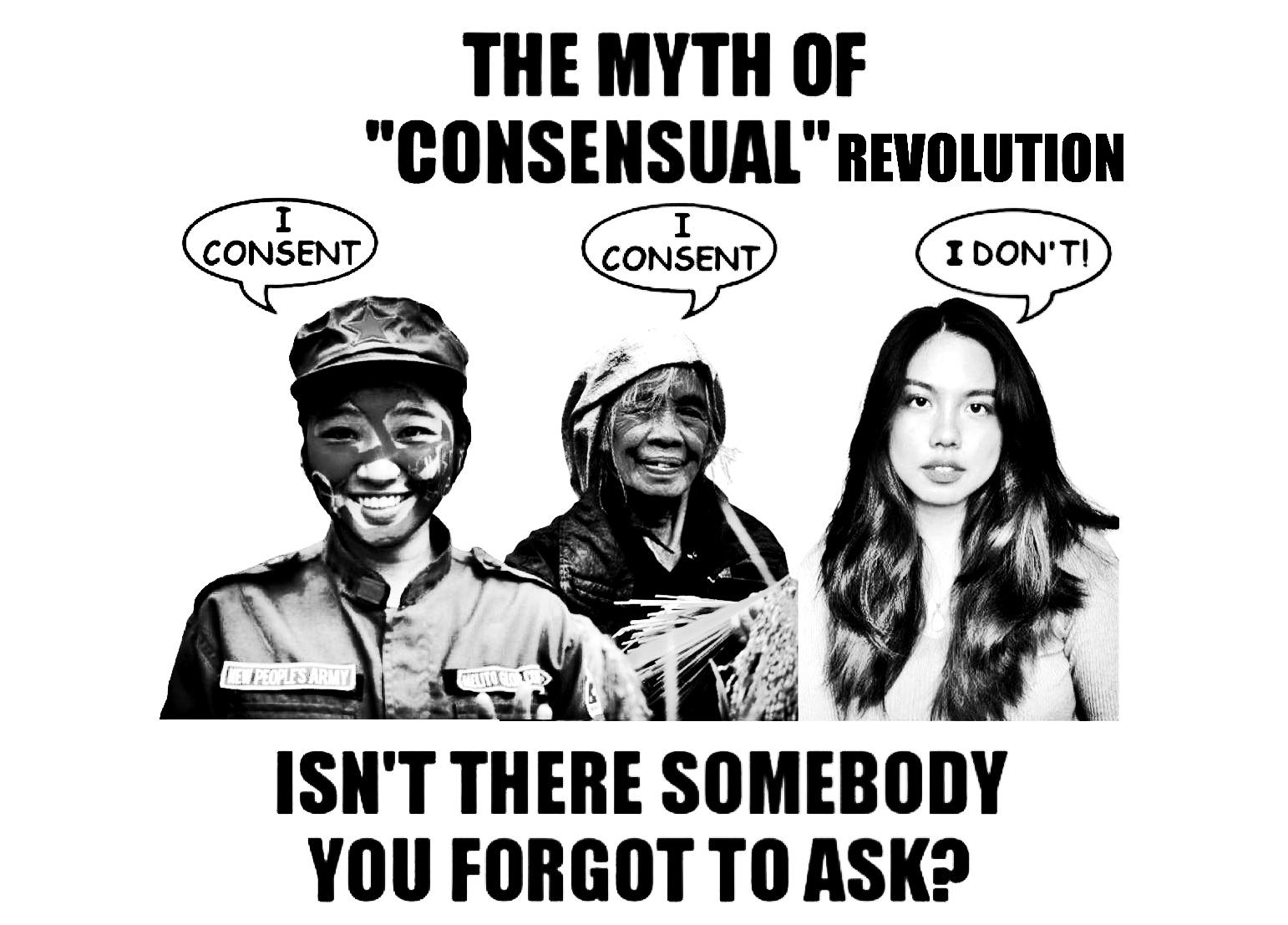
A Consensual Revolution?
The self-evident and banal impossibility of such a thing confronts us and laughs, spattering saliva and all, upon our faces. Only the mercenary intelligence of the by-gone Utopian Socialists and today’s decomposing Liberals alike could conjure up such an imaginary. Does the worker consent to the conditions of her life and thus the very same which poses unto her the question of turning over the world in revolution? This is the question Nikka Gaddi poses to her internet e-mass base, and directs to the motley array of revolutionists of our times.

I. Yesterday
We find ourselves at the summit of liberal emancipation. The worker is free in two senses: free from the land, and free of property. This freedom, though, has been forced upon her. She has no obligation to the land and to a lord, and she has no property to sell to make a living. What she has is pure, purposive, creative human ability to labor. So when the worker engages in the labor-market, she engages in it as a seller of labor-power. Thus far, none of this has been to her active consent. Torn from the commons by enclosure and statute, her ancestors’ subsistence stripped away so that she might stand “free” before buyers of labor-power, this was the original compulsion that made her a worker in the first place. Then we have a freedom of the herring to be salted.
Proletarianization is precisely the process of de-subject-ification—i.e., of dehumanization. Where liberal bourgeois society relativizes the ability to consent to the sovereign individual, the human subject as such, the proletarian is definitionally not “human”. For the immutable tablets of Universal Human Rights declare unto bourgeois civilization the ‘right to property’, and whom among us has none? And whom among us counts as Human?
II. Who counts as Human?
She finds the Eden of the rights of man, where alone rule Freedom, Equality, Property, Bentham, and enters the marketplace as a legal equal. Having offered up a contract, which she herself cannot pass up else she dies of starvation and cold, trampled by the bustling cities of apathetic urban civilization as a homeless, lifeless body upon the asphalt, she sells her capacity to labor for a day, for a wage.
So the job offer is sealed and thus her labor-power belongs to another. Inside the factory gates her purposive activity is no longer her own, set to work under rhythms dictated by machinery (her ilk had made to the profitable benefit of her employer) and the ticking clock. Every gesture of the arm, every twitch of the eyebrow is prescribed, fragmented, subordinated to a process she does not control. The products of her hands flow away from her into the warehouse and up into the market. She cannot take part of this of course–she gets paid in cash. So to access the fruits of her labor, the worker clocks out of the factory and dons the social role of the consumer. What the worker’s own hands created confronts her as a thing with its own life, a commodity owned by such a thing as “capital”, having grown from her living labor yet utterly alien to her. “Capital” dictates the rhythm, intensity, and organization of work, and, now as is made self-evident, even of consumption and the conditions of life itself. Wouldn’t you know it, she can’t afford the damn thing! Her own objectified life returns as a power that dominates her very being. The product of her labor acquires a life of its own, and in doing so strips her of authorship over the world.
So her labor dies. It’s dead. And corpses, not content with “weighing like nightmare” on our brains, do nothing but accumulate, so the products of yesteryear, congealed into machines and money, rise up as “capital”—a self-valorizing process that seems to move by its own volition. Capital purchases raw materials, machinery, and her labor-power (by now no longer purposive human activity as such but “capital” in and of itself), combines them, and conjures forth more value. Now the worker is a living appendage of this dead machinery. Capital’s command—accumulate, accumulate!—dictates the length of her day and the intensity of her toil. She is but a personification of wage-labor—and as far as the employer is concerned, a perfectly interchangeable [disposable] pair of hands. Her desires, her pains, her creative impulses matter only insofar as they can be disciplined into profitability.
In the completion of dehumanization, the proletarian becomes a living nerve grafted onto a dead body that, vampire-like, drains her life-force of every single drop.
Driven by the blind compulsion of self-expansion, this system periodically convulses into crises. It produces too much. Actually, she produces too much. The machines stutter and stop. She, having been too productive, is expelled onto the street, joining the “reserve army of labor”. Effectively she is pronounced dead, and the market periodically performs necromancy on that great mass to raise them to the status of undead, zombies haunting the living, threatening other workers by pushing the pressure of wages downward in competition with each other.
The myth of free contract shatters against the irrationality of a crisis she had no hand in creating. She starves because there is too much food! But “too much” is a relative thing, too, its meaning acquired according to the imperatives of profiteering. So she goes homeless because there are too many homes, becomes a thief because there is too much money, dies because there is too much medicine.
III. So the dead rise
Thus far, none of this has been to her active consent.
Out of this repeated whipping of booms and busts upon her flesh, repeated across millions of lives, whether by the blue moon’s chance or a never-again realignment of the stars, a “necessity” roots into the earth’s crust and forces a crack upon it to bloom in open air. The impossibility of living under these conditions ceases to be a private misfortune and becomes a collective condition. The worker, atomized by competition, is welded together with other workers by this immense suffering and impotence they all share. Even then, this is not to her active consent, but forced upon her by the excruciating pain of the empty stomach boiling in acid, the splitting pain of cracking bones. So the dead rise up, revolting against death. They take up the labor of grave-digging.
Observing the irreducible suffering of the working people in his time, and the advances in class struggle achieved thus far by history, Marx notes with exceptional clarity: “What the bourgeoisie therefore produces, above all, are its own grave-diggers.”
Even revolution then is not to her active consent. To escape this world, and in fact to destroy it, to smash it to pieces and burn it to ashes, to leave nothing standing in front of her—this is a most profound need, a world-historic necessity, forced upon her by the radical unfreedom, precisely in bourgeois freedom, that has defined her entire non-existence. The expropriators are expropriated—they must be expropriated. The fetters must be burst asunder. She is delivered into revolution by the full force of her dehumanization.
Only on the far side of that rupture does the possibility of freedom flicker into being. The working people are forced to make the leap to the ravine, in the rift of the realm of necessity and the realm of freedom.
IV. Guilty on three counts
So the liberal pieties about “consent” have been exposed. The solemn ritual of free will hollowed by the dull compulsion of the empty belly. Revolution by a majority vote in the parliament of the champagne-quaffing Socialist Petty-Politicians, the whole sorry carnival, with the interminable functionaries who have never felt the lash of real hunger—notwithstanding the traitorous salt-of-the-earth Labor cretins learned in the ways of machofeudal populism—is the wet dream of a stratum too impotent to imagine its own end except as an extension of its own procedures. Put simply: the working people cannot consent to revolution because they cannot consent to anything at all, insofar as they are, for the foreseeable future, to remain as workers. Proletarians are cattle, definitionally speaking. The root Latin of the word quite literally means ‘offspring’ (or the producer thereof being the sole source of one’s value to society). Consent itself is a category of bourgeois right, the legal form of the isolated monad, and it evaporates at once should we grasp that the subject who would consent is already the product of the very relations she is supposed to overthrow. So far, so good.
But what of those who, scorning this liberal wet dream, propose instead to make the revolution—to seize history by the throat with the iron will of the Party and the barrel of the gun? Here we encounter the second face of voluntarism, no less idealist for its martial postures, no less trapped in the inversion of materialist understanding for its pretensions to scientific strategy. The consent of the few makes no revolution but a hiking trip toward ranges infested by gun-touting State dogs, foaming with rabies at the mouth at the sight of dead students and journalists and scientists and farmers—leaving nothing behind but corpses martyrized in the pages of Ang Bayan and the smoking ruins of displaced communities. If the liberal imagines revolution as a sign-up form penned by willing individuals, the voluntarist imagines it not really that much differently, as a project executed by The Willing Few—the Party-army and the guerrilla column that replaces the absent class with its own motion and blood. If Nikka sees history as a negotiation among competing blocs of influence, National Democrats see it as raw material to be sculpted by sheer partisan audacity. Despite appearances, both fundamentally agree on the decisive point, which is that revolution is a product of the will. They merely disagree on whose will counts.
This shared ground is the very foundation of what has been known to the Left as the pathology of activism—the privileging of the motion of struggle itself as the index of revolutionary politics, the frantic assumption that, with enough Action thrown at one’s object, which could be anything, all shall be well, and will transmogrify into qualitative political development regardless of what the objective balance of class forces permits. Activism is the nervous tic of a politics that cannot wait, that cannot bear the immobility imposed by an unfavorable conjuncture, and so fills the void with ceaseless Doing. Its theoretical grounding, voluntarism, is the inversion of the materialist axiom that social being determines consciousness, substituting the overdetermining will of the organized, willing, Consenting minority for the actual development of the capital-labor contradiction as the motor of historical change. And its practical, tactical expression is invariably the adventurist attempt to force revolutionary outcomes through audacious blows when objective conditions do not support them, generating not the awakening of the masses, who remain in their day-jobs and villages watching, often with scorn, yet another self-immolation at the altar of “terrorism” and its impatience, but the exposure of the Consenting to repression and the destruction of organizational capacity that took years to build.
These three counts are the symptoms of an inability to grasp capitalism as a totality whose contradictions evolve according to determinate laws that constrain what is politically possible at any given moment, and the symptoms make the rot worse. They are the rage of the impotent will.
The People’s War, we are told, very much unlike the urban adventurists of Manila–Rizal just some decades ago, is a scientifically calibrated strategy, a long march through stages, a patient accumulation of forces that awaits the ripe moment. The guerrilla-liberated zone is the embryo of a new state; the Party-army is the formal expression of political power from the gun. This is voluntarism in its fullest institutional elaboration, and its apparent opposition to adventurism is precisely what makes it lethal as an opportunist rot. For the voluntarist logic is not an accidental excrescence on the PPW; it is demanded by its premises, by the very analysis that claims to ground it.
What is that analysis? The bankrupt semi-feudal and semi-colonial thesis, by mistaking the specific form of capitalist subsumption in the periphery for a hybrid of modes, writes the proletariat out of the script. The worker is no longer the subject whose very existence as variable-capital, as the living negation of the capital relation, necessitates it to be the grave-digger of the capitalist mode of life, but becomes merely one ragbag of The People to be mobilized, organized, and led under the capacious tent of the Party, who, having formalized the path forward, provides the “socialist perspective” of the petty-bourgeois revolution. But if the Party is not the concentrated expression of a class that is already, in its being, the antithesis of capital, then what is it? It is but a substitute, the few that must make the revolution because the actual movement of the class cannot be trusted to produce it. The Party-army is the world-historical subject, divinely annointed by itself, and Protracted War is simply the form through which the Consenting labors to bring forth a new society from the womb of the old, stillborn and blue as the baby always comes.
But the gun is not the servant of class power but its surrogate metallic fetish. The “new democracy” that PPW aims to build is a capitalism without compradors, a national capitalism with a red flag, and its historical role is not the abolition of wage-labor but its generalization under a different (crucial: Patriotic!) administrative configuration, and thus a voluntarism swollen into a state developmentalist project, and it is a bureaucracy no less anti-communist for the blood it spills.
Now comes the objection, half-sob, half-accusation: “But what should we do, then? Just wait? Sit on our hands and let capital grind on while we polish our theoretically pure knobs?”
This objection only appears compelling, of course, if one has already accepted the voluntarist premise that the only alternative to the National Democratic struggle is the inertia of the impotent sect. But this is precisely what is being contested. The communist response to a society mired in counterrevolution is not to pretend the conjuncture is something else by substituting the Will of the Few for the movement of the class. Nor is it to dissolve the program into opportunism by chasing the majority in conditions where the majority is atomized, passive, and saturated with bourgeois ideology from scalp to sole.
What militants embedded in the orbit of the CPP-NPA can concretely do is not nothing. It is the same thing communists have always done in conditions that do not permit the direct revolutionary assault: preserve theoretical clarity, refuse to subordinate class politics to interclassist alliance frameworks, work toward organizational forms that correspond to the general interests of the Filipino working class as a global class rather than as a national-popular subject, and above all, resist the catastrophic temptation to treat the party as the class. Keep the knife sharp. But the harder answer, the one that cuts to the bone, is that the CPP-NPA’s theoretical foundations are not errors attached to an otherwise sound communist core. The semi-feudal thesis, the substitutionist logic, the national-democratic horizon are not just tactical mistakes but precisely the direct expression of a voluntarism that can never, by any number and intensity of rectification movements, become the real movement that abolishes the present state of things. The rot of a few apples rots the entire barrel.
Ultimately both the cretinous Liberal and the gunpowder-headed Maoist are trapped in the same pathetically bourgeois subject-centered metaphysics that cannot grasp the dead-weight of prehistory, the blind autonomized movement of capital that drives toward its own negation without asking anyone’s permission. The working people do not consent to revolution and neither do they manufacture it in the guerrilla base area or the party headquarters. The revolution is forced upon them by the intolerable totality of their own dehumanization, and it is forced upon them with all the violence of a history that has never once consulted them. Only when the realm of necessity is brought under the conscious collective control of the associated producers and the working day is shortened to open the space of free human development—only there can the question of revolutionary “consent” even arise.
The People’s War is deemed guilty on three counts of Voluntarism, Activism, and Adventurism, and it must be forced to realize this guilt through the baptism of fire. History necessitates it.
V. The realm of freedom
We shall not “intend to save” anyone.
To consent to this life in any full sense is impossible. The conditions of existence are not available as conditions to be accepted or refused; they simply are, the way gravity simply is, and what passes for consent is only the daily reproduction of what has been given.
Consenting to life is possible only to new people. What propels us is the dead-weight of the human prehistory that is class society unto its end, and we are thus driven to leap by the impossibility of continuing as we are. Communism, the real movement, is “the riddle of history solved”, the leap from the realm of necessity to the realm of freedom.
Just as against Rome the wild hordes were needed – so that so many and great useful contributions to the organisation of people and things would not be lost – which were unconscious contributors to a much bigger revolution still far away in time, we want the gates of this bourgeois world of profiteers, oppressors and butchers to be struck by a powerful barbaric wave capable of burying this world among itself.
Amadeo Bordiga. “Forward, Barbarians!” (1951)