Category: Marxism

  • To Lead, Not Learn From

    To Lead, Not Learn From

    Introduction

    All social life is essentially practical. All mysteries which lead theory to mysticism find their rational solution in human practice and in the comprehension of this practice.”

    Karl Marx, Theses on Feuerbach, VIII

    The red line for every single socialist has historically been: actually organising the working class.

    In practice, this simply means:

    1. Appearing as a real authority to the working class.
    2. Giving the working class the weaponry of its emancipation.
    3. Telling the working class who to direct that weaponry against.

    It has always been in evidence that the proletariat does not want to ‘teach’, but instead it wants to be ‘taught’: namely, given a gun and told who to shoot. Until communists are in a position to provide this, which presupposes a movement of real class organs, then the communists will not win purchase among the working class.

    Largely, this is because today’s Marxists are, to be blunt, frequently scared of their own shadow. They are ridiculous idiots who do not really identify themselves as part of the working class. It is hard to find a sect or tendency or ‘vanguard’ that does not tout its capacity to learn from the workers, to understand what it’s like on the ground.

    Are the communists, in the world of the modern Marxist, the foremost representative of the proletariat, the class’ most politically-developed vanguard?

    No! In the world of the modern Marxist, in fact little more than anyone else who calls themselves a ‘socialist’, the proletariat exists as a moral authority! The proletariat, so inept, so lacking in class-consciousness, so manifestly inert, the proletariat who, in the west, may well readily follow the ready-paid piper of bourgeois electoralism right into the jaws of rightist “populism”; this is the proletariat we ought learn from?

    And this, itself, could be read as me making a moral indictment of the proletariat; as me chastising it; as me presenting the failures of communists as the failures of proletarians.

    But the failures of communists are the failures of proletarians; the failures of proletarians are the failures of Communists. This class is the subject of our doctrine and the state of the class informs the state of the doctrine. Accountability to the doctrine involves lucidly regarding what our predecessors left us to work with.

    Friends, I do not know whether you have laid your sensitive eyes upon the modern workplace, but these people have little to teach you. Indeed, I can recall the poetic wisdom of my elder coworker, his sternly-taught life lessons, his perversely compelling diatribes about the various supposed cruelties inflicted upon him by the women he has been romantically involved with. He is very well-acquainted with the mythology of work; of rolling with the punches, it is what it is, of enjoying the little things and accepting the world’s shit but you work your hardest. He has had a very storied life.

    What he is good at is coping with work. Indeed, if we were about coping with wage-labour, of making it more spiritually comfortable, then he would have a lot to teach us.

    Notably, this is not historical materialism. Historical materialism teaches us that, in fact, the point is to abolish wage-labour. I have shockingly little in common with my elder coworker in this regard.

    I have given years of my life to the study of the Marxist doctrine; of the politicisation of the intimate. Of the crises of faith, the reassurances, the meetings, the organisation, the Sisyphean assailing of a task most deem impossible.

    I know more about historical materialism than my coworkers. If a class-conscious organ was formed around my workplace, I would likely be selected for doctrinal leadership.

    This is something you are not allowed to say in modern Marxism. You are meant to be humble. You are meant to, in fact, concede to a ‘democracy’ of your coworkers, rather than the stratified command already present in the workplace. Alike the bureaucrats we hate, who tell us how we ought to do our job, and who are ignored when the tactical-level decision making is produced.

    ‘Leadership’, to these people, means the office. It means the union, the bureaucracy, the state.

    It can never refer to real power, which is in evidence in practice, not in form.

    We must not fetishise our colleagues as proletarian mystics; they are alike the Soviet peasants who may well have possessed profound conceptions of God and religion. But when the first radio towers were erected in their villages, they stared in raptest awe; Communism brought them miracles far greater, far realer than their saints.

    In the absence of anything else, the way we erect these radio towers in the modern day is to deliver a victory. That first victory–the real proof that there is lurking power that exists in the hands of all the class–is only something communism may truly deliver in practice; communism as the real movement, within the present social order, positioned toward the abolition of the present state of things.

    And despite the crude idiocies of the Marxists, I do believe they are capable of rising to this task. And in doing so, they might learn, as we all learn one day, that this great and awful word, “Communist”, is not a mark of a martyred apostle, or a beast of burden to carry our woes.

    Instead, they will know “Communist” is a title, earned and kept, and carried with pride.

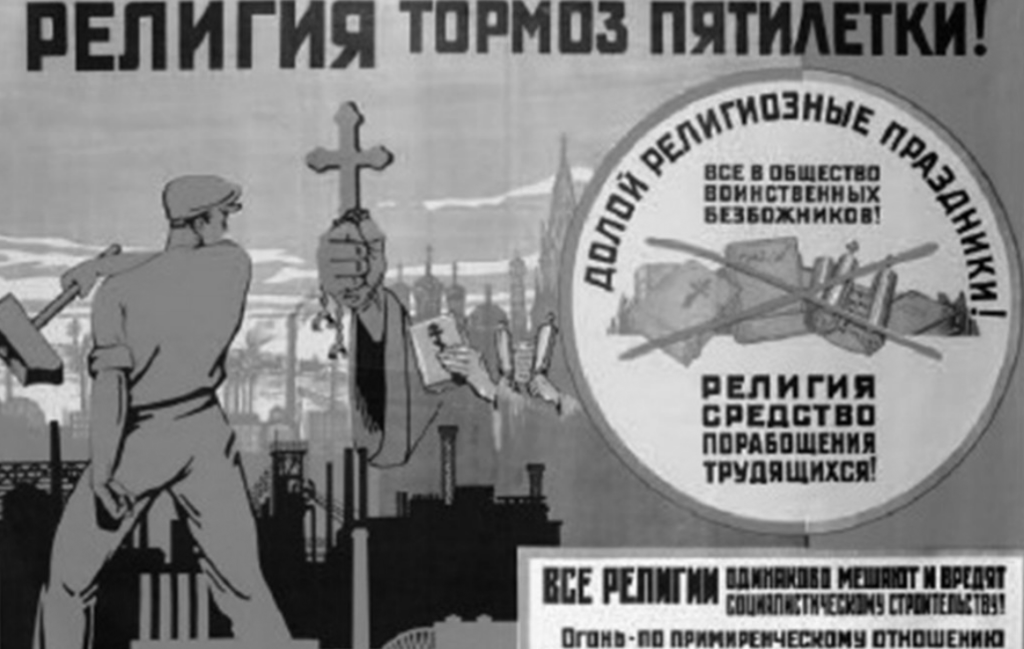
    The Working Class: Religion vs. Reality

    Education workers, and the Communist Party as the vanguard in the struggle, should consider it their fundamental task to help enlighten and instruct the working masses, in order to cast off the old ways and habituated routine we have inherited from the old system, the private property habits the masses are thoroughly imbued with.

    Lenin, “Left-Wing” Communism: An Infantile Disorder, p. 365

    I

    There appears two ‘working classes’: the working class as a political subject that is being organised (the class-for-itself), and the idea of ‘the working class’, which is tantamount to a civic theology concocted around the conditions of wage-labour (a fetishisation of the class-in-itself).

    II

    The strength of the worker-religion is weakened by the real organisation of the political subject. This is because, far from building a real unity, the struggle is about delineating the class and its enemy in a real sense. Coworkers who do not strike become scabs; allies of management become workplace cops.

    III

    The working class as a political subject can be ‘learned from’, but only as a product of its action in accordance to an organic doctrine.

    This presupposes an organisation of the working class for itself, i.e., for its abolition, by which this political subject can exercise its power.

    Without the organisation, the worker-religion is all that’s left, and we conclude that wage-labour is solely instructive in the proceedings of consciousness; that it is the method of learning, rather than the grounds upon which it occurs.

    Yet, the workers curiously resist history’s attempts to turn them into communists.

    IV

    The real class unity is not about uniting class-sects; it is about establishing who is for and who is against the class.

    For this to happen, there must, again, be a class organisation.

    V

    If elements of the proletariat oppose their own liberation, they are not simply misled from their real interest; they have accepted the religious class-order over the real one. Whether this comes from an attempt to preserve a fleeting hierarchy, a convoluted false consciousness, or sheer stupidity, does not matter.

    VI

    The working class as a subject does not resolve its disputes democratically. It resolves its disputes forcefully: separation, segregation, and, when tensions are high enough, elimination. The class-for-itself, wishing to abolish the class-in-itself, is in conflict with those workers who simply identify the class-in-itself as their essential state of being.

    In order for the class-for-itself to come into being, a definite labouring mass must have identified the extent of its own potential power. In other words, it must have been made lucid of its real conditions and then acted upon them.

    VII

    When the class-in-itself becomes the class-for-itself, it has given a definite form to what can now be called ‘the Party’.

    VIII

    The Party, representing the organisation of a real movement, possesses a doctrine. This doctrine’s determination cannot be a product of any democratic force within the Party, but the real authority behind its operation.

    It is a mark of dogmatic institutionalism to suggest that the arrangement of the Party’s organs change the doctrine to which it will always adhere: the abolition of class society. The premises of the abolition of class society do not actually change because of the decisions of a party’s democratic organ.

    The Marxist doctrine is not divined, but developed. It lies beyond the imagination of some people that a doctrine’s evidence is in its success, not its determination.

    IX

    If a clique were to attempt to dethrone the revolutionary objective of world-revolt, self-abolition, et cetera, and it were in the means of the class to reject this clique, the answer is not to concede to a democratic abstraction, but to operate via real power structures to nullify them.

    X

    In all of this there is a real programme for liberation.

    But at every moment in this programme, there will be those who ask about the sanctity of the worker-religion, who demand the whole class be represented, that there is moral sanctity to the root of the proletariat’s oppression–their status as proletarians.

    In protection of the class’ angelic virginity, the devout apostles of the worker-religion demand a return to democratic form; they may even suggest that the proposal of a vanguard organisation itself, even with no actual working organisation in question, is a form of manifest harm to this celestial virgin.

    This ludicrous superstition must be driven out of the skulls of any class-conscious proletarian; that they ought love their work, that they are purer, greater for their sacrifice at Capital’s altar.

    We demand, however, the altar’s desecration; a real overthrow of the ridiculous demand we kill ourselves for the money-god.

    Fetishisation of the Instant Form

    “All that is solid melts into air, all that is holy is profaned, and man is at last compelled to face with sober senses his real conditions of life, and his relations with his kind.”

    Karl Marx, Manifesto of the Communist Party, p. 16

    XI

    The objective of present-day communists, when it comes to questions of organisation, appears as the identification of latent consciousness. Thus begins the great search for a hidden revolutionary mass that eludes us; so we may conclude the answer is the lumpen, or the racialised masses, or the ever-waged queer rebellion against the family, or the imperialised and colonised periphery, etc.

    Some Marxists, working on age-old Eurocentric divinations, even go so far to actually conclude that the first-world masses are, in fact, the most developed revolutionary subject!

    We look for a group to whom we may prescribe consciousness, to contort into the shape of the Marxist doctrine. Then, when they do not behave as this perversity has demanded of them–when there is still no real communism in evidence–the enemy can become literally anything but the bourgeoisie.

    It is very rare indeed for a Marxist to conclude that consciousness is not a latency of any specific sectional identity, but a world-historic immanence of capitalist production in general; that the real process is supreme over the fetishised form.

    XII

    This form-fetishism can be retroactively deemed correct if social revolution occurs in such a fashion that it is led by members of the fetishised form. The danger emerges when this form is then transposed beyond immediate struggle; when the present attempts, in increasing desperation, to reach into the past. The form-fetishism is itself fetishised, and the attendant doctrinal modernisations are transformed into a class-religion, which becomes a dogma. When the dogma is proven incapable of meeting new needs, it is ‘revised’, and there is this bargain struck between the dogma and revision, where both are understood as bad, but in relation to one, essential doctrinal truth.

    GLOSS: In history, we can see this no clearer than with Mao.

    Mao’s concept of New Democracy is based upon ‘camps’ within society that build socialism together. This emerges from a form-fetishisation of a particular character: the “peasant”.

    The peasant is understood as inherently non-proletarian; but in China, there was indeed in many cases a C-M-C/surplus value extraction relationship between rural tenants and their landlords. Yet their particular place in the town-country distinction was fetishised as a category unto itself, and thus any corollary interest between the proletarians and ‘the peasantry’ was collapsed into a ‘contradiction’ to be resolved ‘democratically’.

    Mao talks a lot about ‘dogma’ and ‘revision’, all in relation to a doctrine based on false premises. Today, Maoists blame the rightist clique for its complete and utter destruction of ‘Chinese socialism’, and lament the orphaned child of a forgotten time.

    XIII

    Now that the form-fetishised spectre appears as a real force in sect and tendency, some who claim to be on the ‘Communist Left’ will belabour themselves with the vanquishing of this spectre. They demand progress toward a ‘class unity’ in the face of racial, gendered, and national hierarchies. Notably, this demand does not really abolish the reality of these stratifications.

    One can only wonder how this led to a severe overpopulation of blisteringly white left-communists.

    XIV

    The real class-unity is not within the class-in-itself, but the class-for-itself; the Party is a product of a real unity in the latter, rather than a force instrumentalised for the unity of the former.

    To simplify: if a class-organisation appears as a movement of racialised workers, the task is not to demand an allegiance to ‘white workers’, but instead to view class struggle as an abolition of racism; to view Capital as the enemy, not white Capital.

    XV

    So: the Marxist doctrine does not inform people how to halt their struggle, but rather how to continue and elevate it; to bring it to its logical conclusion, to smash Capital and all who stands in its way. If the sectionally-supreme workers, in that instance, decide they will stand in Communism’s way, the Marxist doctrine, which cares little for whiteness, manhood, cisheterosexuality, or anything else, happily allows their political subjugation.

    XVI

    Vulgar ‘class-first’ politics thereby appears not as a negation of sectional identitarianism, but the fortification of the dominant sectional positions.

    Still belaboured by an obsession with majoritarian consensus, with ‘democracy’ (or whatever else they may call it), these vulgarisers believe that the class-for-itself must seek assent from its immediate enemies, in order to appease the Godly beliefs of the worker-religion.

    Through their attempt to return to base order, they have only found themselves in the base order of civil society: affirming dominant race, gender, and national norms.

    XVII

    A true class-politics, divorced from all pretensions, is one that is unconcerned with the practical assent of anyone other than they who are necessary for social revolution. This understanding is what allows a real liberation to take form.

    GLOSS: This understanding appears callous, it appears cruel; it is the understanding capital gives us nonetheless. One might ask: the promises of the communist revolution are great indeed, but how can you help me, in the here and now?

    The answer is: as we always have. By sheltering those in need, and having those to shelter us; by building support structures that can stand the test of weary souls.

    Marxism, however, is not the doctrine of living under capital. Marxism is the doctrine of abolishing it. Through this narrow understanding, we liberate ourselves from needing to contort it into an intimate politicisation, to explain the minutiae of individual selves via its lens, to treat our transient organs as a real movement.

    You’re allowed to help your friends and peers, and you don’t need sanction from Saint Marx.

    XVIII

    This understanding is what allows us to properly contextualise and elaborate on movements of the oppressed, directed for their liberation, rather than click our tongues and demand they stop.

    GLOSS: Take Palestinians, who we will take in evidence the interest that they see an end to Israeli oppression.

    Those who identify imperialism as the primary contradiction will say: the tactics of Hamas are the primary weapon in our fight.

    Class-first vulgarisers will say: neither Israel nor Palestine! And try and delude themselves with the ridiculous proposition that “Palestine is imperialist.” There are real people who say this and demand you take them seriously.

    The Marxist position is simply to accept that the Palestinians struggle as they do because they have to, and that we cannot tell them to stop struggling in the certain way foisted upon them, that we can only elaborate upon that struggle, to say: a Free Palestine is an excellent goal, but why simply stop there?

    And in fact, we should organise our own ‘national workers’ to advance themselves, and in revolutionary strike action disrupt the supply chains of Empire. This would also, presumably, help the Palestinians.

    Should such a development arise, we could then see in the mutual struggle, no matter how divorced by distance or subsistence condition, the emergence of a common interest; something capable of developing into a united political subject.

    But this would only be a product of that organisation, of that immediacy; we cannot prescribe it beforehand.

    In other words, the united emergence of the Party is not an essential product of the present historical instance, but the real outcome of invariant historical forces. Doctrinal ‘modernisation’ is the assumption that the Party is anything but.

    XIX

    Communism remains an immanence to the invariant properties of capital. The question is not how instances wrap themselves around these invariants, but to understand how these instances are the product of invariants.

    Unions and Class-Consciousness

    “The history of all countries shows that the working class, exclusively by its own effort, is able to develop only trade union consciousness, i.e., the conviction that it is necessary to combine in unions, fight the employers, and strive to compel the government to pass necessary labour legislation, etc.”

    V.I. Lenin, What Is To Be Done?, p. 17-18

    XX

    It is understood that trade union organisation only produces trade union consciousness.

    GLOSS: The remnants of the old trade union bureaucracy remain some of the most infernal vestiges of British left-TERFism. Bereft of any politics left to actually do, and feeling constantly undermined, the only shit they’ve got left is to obsess about the gamete (something they very clearly do not understand). “Gender critical” thought becomes another religion, the sigh of this oppressed, gelatinous creature we find at the heart of reformist politics.

    XXI

    Not all unions are the same. Workplaces that are in the embryonic process of unionising–and are thus less concerned with the construction of an elaborate union bureaucracy–are not as ossified as a developed union.

    XXII

    Given the tendency of unionisation to self-nullify, to assemble structures that strangle even the most dedicated root organisers, to seek collaboration and ‘peace’ with the bourgeoisie, it is clear that at some point the negative force of class struggle results in the creation of a positive politics.

    XXIII

    The proletariat’s world-historical position is not a position at all, but the negation of the position of class society; thus follows the negation of the negation, the fact that the ‘proletariat’ itself is simply an infliction of the class society it is immanent to, and historically strives to abolish.

    Socialist experiments in history can have their failures explained by their points of defeat whereby they were compelled to establish positions for a class society: the failure of international revolution, the creation of a ‘socialist civilisation’ in its stead.

    Trade unions, likewise, lend themselves to a positive order.

    XXIV

    When class organisation extends beyond a certain scale, it must be maintained.

    The Party finds its definition in what occurs when a supreme class organ arises for its maintenance, with a negative, abolitionist programme of overthrowing the old society. Trade unions are the emergence of a class struggle that understands itself in isolation.

    The real union is the bureaucracy that emerges as “the first line of defense of the working class”, the means by which the encroachments of capital are fought against through organisation and strike action. In the absence of a negative, world-historical doctrine, however, this can only lead to the production of a union position; union bureaucrats, union identity, union consciousness.

    Introducing a new doctrine would upend this position and as such it is much harder to introduce Marxism to an established union bureaucracy.

    XXV

    It is the Marxist objective to translate consciousness into a negative class organ before the imposition of a positive politics.

    For this to be in evidence to workers, Marxists must provide, in evidence, proof of the doctrine’s success and utility to them.

    XXVI

    The only way for the utility of Marxism to independently arrive in evidence is for its doctrinal intervention at a moment of crisis to elaborate existing struggle.

    In other words, the doctrine must [a] be correctly developed, and [b] be ready for application via existing, communist class organs, constituted not as the first line of defense, but as the first line of offense.

    XXVII

    To those who say a diagnosis of spontaneity to revolution serves to intellectually postpone it indefinitely: don’t worry, the crisis is arriving soon.

    Some say it is already here.


    This article was syndicated via Headcase Kultkrit

  • Who’s afraid of dogma?

    Who’s afraid of dogma?

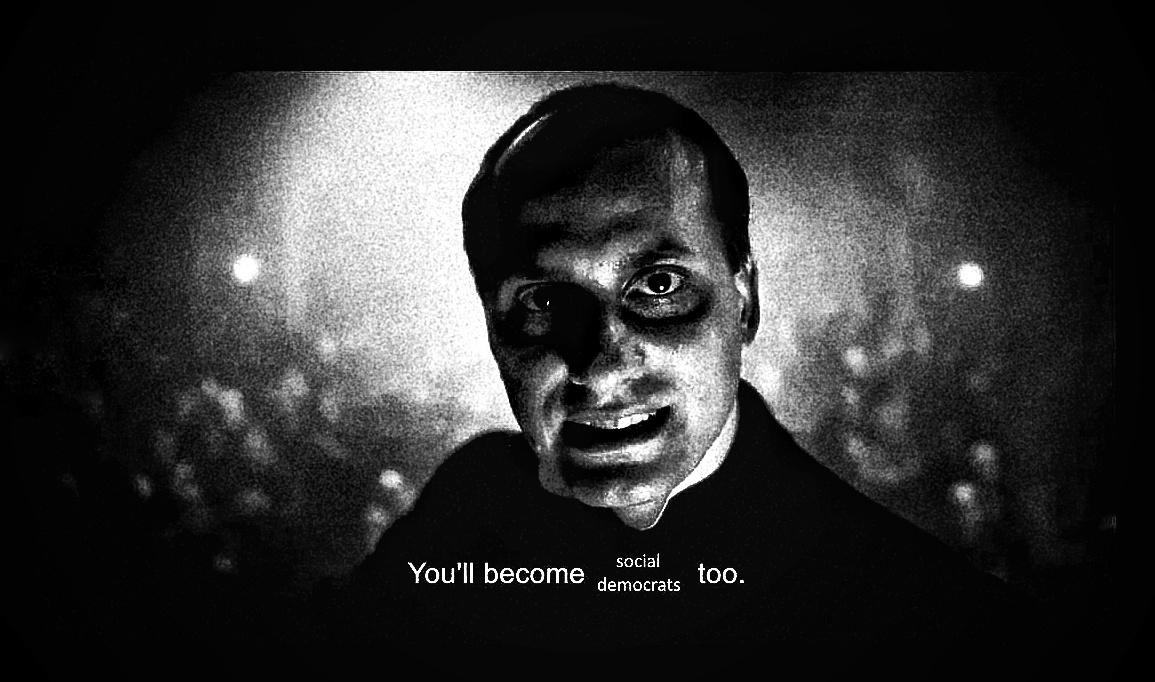
    Kontra-sokdem

    The principle of the historical invariance of doctrines which reflect the tasks of protagonist classes, and also all the potent referring back to founding principles, stands opposed to the gossipy assumption that every generation and every season of intellectual fashion is more powerful than the previous one. It rejects the whole silly film show which portrays the relentless advance of civil progress, and other such bourgeois prejudices from which very few of those who lay claim to the adjective “Marxist” are really free. It is a principle which applies to every great historical period.

    ICP. The Historical Invariance of Marxism.

    Yesterday

    Social Democracy was born blue. If one wishes to trace the putrefaction of the socialist movement back to its first act of betrayal, one need only stand at the threshold of August 1914 and take in the stench of the German Social Democratic Party voting for war credits. In the sublime of parliamentary prostitution, the entire tradition of pretended proletarian politics immolated itself on the altar of national chauvinism, and the smoke that rose from the burnt offering was thick with the rhetoric of “lesser evils”, “national defense”, and the eternal immaturity of conditions.

    It was the culmination of decades during which the party of Bebel, Liebknecht, and Luxemburg had become a well-oiled apparatus for administering capitalism under the incantatory headmast of socialism, its midwives the humble revisionist Bernstein and the unctuous center-keeper Kautsky, men who transmogrified Marxism into a quasi-progressive Church of good manners and trade-union accounts. The movement that had once declared that the emancipation of the working class must be the work of the working class itself had, by bureaucratic mitosis, produced a leadership with a credo that the realization of socialism on earth must be subsidized by the bourgeoisie.

    Social Democracy blossoms into its own florid and farcical blooms in the Philippine tropics. Two in particular, conjoined twins born from the same, each accusing the other of being counterfeit (cf. CPP: “Akbayan is pseudo-leftist”), while both replicate with the faith of a provincial imitator their decomposed European ancestors.

    On one side, we have the citizen-politicians of Akbayan, who, having emerged from the wreckage of the Maoist Communist Party’s renegade faction in the 1990s, openly genuflect before the ballot box, spouting the pieties of “democratic socialism” which, stripped of its pleasant upholstery, means nothing more than administering neoliberal austerity with a human face and a well-remunerated NGO sector. Their project is thorough honest whoredom to the electoral circus so transparent in its class collaboration that one almost admires the candor with which they substitute class struggle with focus-group-tested platitudes about “inclusive growth” and “social accountability”, as though the problem with the dictatorship of the bourgeoisie is that it has not been sufficiently accountable to its subjects.

    On the left side of the isle is the National Democratic movement, that lumbering beast of dog-eared copies of On Protracted War and stale united-front hagiology, which imagines itself the revolutionary alternative because it wears a uniform and carries a gun. The National Democratic Front—and its puppet-master Communist Party—has perfected the insurrectionary aestheticization of Social Democracy. They pursue a “national democratic revolution”, theoretically the spiritual continuation of the aborted Katipunan revolution, that, in its obsessive staging of tactical alliances with any disgruntled landlord or provincial warmonger who can mutter patriotic anti-imperialist slogans, remain tailing the national bourgeoisie, becoming its pressure group in the hills and, when the political winds shift, its emissaries at the peace table. Their armed struggle functionally becomes a bargaining chip for what they project to be eventual coalition governments, betraying a long historical record of failure from Macapagal to Duterte, and “genuine” agrarian reform that preserves private property in land, all while humming an off-key Internationale into the humid night.

    The NDF and Akbayan despise each other with the special venom reserved for rivals fighting over the same swill; the former scorns the latter’s parliamentarist naivete, while the latter scorns the former’s out-of-date militarism. For communists, it has always been clear that they are opportunist species of the same genus that feeds on the carcass of revolutionary possibility, one through the electoral road and the other through the chimeric people’s war. Together, they form a social-democratic archipelago in civil war.

    The German revisionists of 1914 offered the Kaiser their patriotic bodies; the Filipino opportunists of the 21st century offer the capitalist state their bodies electoral and ballistic. The humidity accelerates the rot.

    Today

    And when one points out these obscenities, the cry goes up from both camps: “Purists! Dogmatists! Ultra-leftists! Sectarians!” It is the universal squawk of the opportunist confronted with the revulsion of the principled, a word-spell to exorcise the specter of class truth by diagnosing it a psychopathology. Palatino, struck with creative inspiration, would call the Left critics of the Villar-BAYAN situation in 2010 as “ambitious apostates” and “fundamentalist freaks”. In reality, their accusations of purism is no more than bourgeois phrasemongering that performs the neat trick of dismissing any consistent proletarian partisanship as a personality disorder. As any good socialist knows, cooperating with the ruling classes is simply hard-headed realism forced upon us by le material conditions, which is basically Marxist materialism, or whatever.

    Ironically enough the charge of “dogmatism” is itself the most guilty dogma of counter-revolutionary leftism. Dogmatism is a talisman brandished against anyone who reminds them that the proletariat has interests irreconcilable with those of the bourgeoisie and its satraps. What, after all, does our saintly “anti-purist” actually mean when he prates about the danger of isolation and the necessity of “broad unity”? He simply means that the proletarian movement must put itself under the hydraulic press of the bourgeoisie to prove its willing pacifism and harmlessness, that it must mutilate its demands, purge its memory of the Spartacist Uprising and the Cultural Revolution, and learn the cuckolded language of policy proposals and transitional demands all so that the functionaries may sit at tables with the powerful and feel the warm glow of being taken seriously.

    But after Marxism had ousted all the more or less integral doctrines hostile to it, the tendencies expressed in those doctrines began to seek other channels. The forms and causes of the struggle changed, but the struggle continued. Pre-Marxist socialism has been defeated. It is continuing the struggle, no longer on its own independent ground, but on the general ground of Marxism, as revisionism (…) And it patently follows from the very nature of this [revisionist] policy that it may assume an infinite variety of forms, and that every more or less “new” question, every more or less unexpected and unforeseen turn of events, even though it change the basic line of development only to an insignificant degree and only for the briefest period, will always inevitably give rise to one variety of revisionism or another. The inevitability of revisionism is determined by its class roots in modern society. Revisionism is an international phenomenon (…) [So is] “revisionism from the left”.

    VI Lenin. Marxism and Revisionism.

    One might recall the 2010 dissenter movement within the Maoist Party cohering around the outlet Bulatlatan to polemicize against the Party’s decision to endorse and campaign with the Villar–Marcos tandem; or the 2012 debacle between Akbayan, who was in too deep with the Aquino government, and Anakbayan, who represented in that lightning rally the National Democrat partylists; or the 2016 situation between the butcher Duterte and the all-too-eager CPP–NDF. Just how utterly, inanely pathetic is it, as self-professed socialists, to bicker over who is the Real Partylist™ to be rightfully recognized by the bourgeois state?

    Despite the defeats incurred by sequences of the left throwing itself off a cliff via electoral and activist opportunism, our socialist petty-politicians insist that the next attempt will be different. Meanwhile, stating what is an a posteriori derivation, that is, do not throw yourself off a fucking cliff or you will break bones including your skull, is apparently the naive, puritan, doctrinaire, dogmatic conclusion. But maybe gravity doesn’t apply in a semi-feudal, semi-colonial society.

    Social Democracy is characterized by a remarkable arrogance that it always finds within itself the means to manipulate the material of the State and of capitalist society generally as it freely wishes without permanently staining its hands with blood. The common kernel of all Social Democratic movements today as it was in history, from Noske and Lassalle to Stalin and Mao to Gramsci and today’s Neokauts is that class society, barring the nebulous impression of “present material conditions” (i.e., the electoral prospects), is an open field of maneuver where one can do what one pleases. This of course runs into the immediate problem posed by Social Democrats when convenient of the “need to learn from history”, by which they mean Trump won because the stubborn puritan party of the Communists, comprised of about 20 people maximum in the US, did not vote for Harris, and so Communists must always “vote blue no matter who”. Today, Akbayan lauds the butcher Gibo Teodoro for genuinely no good reason whatsoever, exclaims our friends at the Left isle. We agree in principle in condemning any praise for butchers and lackeys of the murderous state, and we add: it doesn’t need a good reason is the reason; it is an openly Social Democratic party; opportunism outnumbers the platelets in its blood. It would be like asking ice cream to stop melting. The ND Left can get away with calling out Akbayan because it does not admit even to itself that it too is a Social Democratic movement, and thus also an opportunist’s nest. If (or when) tomorrow the ND Left once more finds its pet warlord or neoliberal girlboss to collar itself to, we shall hear the same excuses from its constituents as we today are forced to endure from Akbayan’s.

    Akbayan merely shows the ND Left its future.

    If our petty socialists were serious about self-criticism, they would be Communists! But obviously, self-criticism is also purism, dogmatism, doctrinaire, a ridiculous ask for activists under heavy fire—and activists are never not under heavy fire. What is to criticize? Nothing and everything. More pointedly: what is the measurement for criticism? The common yardstick to both is the democratic principle. This causes major confusion among vacillating activists and the most forward-looking elements of the youth and the working class, because democracy is supposed to be a universal good, an ideal always to be desired, and yet the Democratic Left is at odds with itself for not embodying enough True Democracy. So each side’s criticism of the other fails at the outset. Akbayan criticizes the National Democratic Left for not condemning the NPA, well, what the hell are you expecting? The NPA is the National Democratic revolution! On the other hand the ND Left criticizes Akbayan for “being a fake partylist”, when it has its own mass constituency across classes and sectors that it claims to represent, from women to workers. How does this criticism stand? Apparently because only the ND partylists are the real partylists, and thus they go self-flagellating in front of the democratic bourgeois State, citing like good and responsible republican citizens the democratic Constitution—which as we all know is a highly respected document by the bourgeois itself—in begging for this rightful recognition.

    As I have written elsewhere, the democratic fetish of Maoists and Akbayanites…

    treat democracy as a neutral indeterminate political form that can be tactically occupied and progressively transformed in the direction of communism and “service of the revolution”. Here democracy is instrumentalizable; provisional demands that expand political space, weaken repression, and enable proletarian self-organization, which will later overload the democratic shell and culminate in revolutionary rupture. But in truth what this does service to is the abstraction of democracy from its historical constitution and social function. (…) Democracy operates through abstraction. Its universality is achieved only by suppressing determinate social antagonisms and presenting individuals as formally equal bearers of rights and votes. (…) Class antagonism cannot appear within the democratic form as antagonism without destabilizing the form itself. Democracy is an identity-form that symbolically reconciles material contradictions innate to capitalist society, and neutralizes non-identity in the process of dissolving class antagonism into formal equality. Thus the proletariat ceases to appear as a class confronting capital, but becomes a demographic, if internally differentiated, aggregate whose interests are to be represented and managed in the State.

    Fragments on Invariance.

    But it is implicitly understood that self-criticism is only for convenient times, that is, when each can claim that they are the Party of Self-criticism.

    In a society cleft by class, groaning under the weight of its own antagonisms, there is no such thing as purity in the abstract, only partisanship in the concrete. Under class society, the only partisanship which really exists is class partisanship.

    In class society there is no view from nowhere.

    To be a “purist” is simply to refuse to step into the same sewer as those who would have the workers pay with their blood for a program of class reconciliation. When the Akbayan petty-politico swoons over muh evidence-based policy and le constructive engagement, he is in fact swooning over the maintenance of exploitation and the prison complex of parliamentarism; while as the ND cadre waxes poetic about a historic bloc against imperialism, he is melting the revolution into a gelatinous puddle where communism is dissolved into the interests of the legendary unicorn that is the national bourgeoisie. Despite their mutual bickerings both are at least in complete agreement that the proletariat is too weak to trust its own praxis, and that it must forever be chaperoned by its social betters, i.e., the ever-benevolent, educated, samaritan, democratic petty-bourgeoisie.

    “Purism” and “dogmatism” are, then, nothing but the phantom names for the terrifying idea that the working class might set itself in motion without permission from the middle-class activist-managers and the commissars of the people’s war. We are accused of fighting a phantom, but it is the anti-purists who inhabit a spectral world in which classes can be reconciled through dialogic magic.

    Talk about religious psychosis!

    Tomorrow

    Our Great Elector is the rifle in the hands of the insurgent worker, who does not dream of depositing a paper ballot but of striking the enemy.

    ICP. The Trotsky Question.

    From the position our good friends so cavalierly deride as “purist” we report back with cheer: the class must amputate this carcinogenic limb of opportunist cretinism or it will die of tetanus.

    The proletariat is an organism perpetually assaulted by fevers and viral infiltrations, each a syndrome of immunological compromise that persuades the body to attack its own revolutionary antibodies as foreign invaders. When Akbayan preaches the sweet reasonableness of incremental reform, it introduces a toxin that sedates the class into believing that capital can be negotiated with and that the revolution is itself the slow rearrangement of parliamentary seating; its entire practice is a prolonged suicide note written in the prose of economic conferences and civil society workshops where former student radicals and veteran ex-cadre learn to say “stakeholder engagement” without vomiting. When the National Democratic movement, on the other hand, sends its cadres to organize peasant communities around petty-bourgeois “land-to-the-tiller” programs that leave the structure of wage-labor and local usury intact, it introduces a revolution that is at once its counter-revolution. Social Democracy is the antibody of the Party of Order, policing the proletarian body so that it never quite develops the fevers necessary to expel the parasite of bourgeois ideology entirely.

    The “dogmatist” who still clutches the threadbare texts of Marx, Engels, Lenin and the milieu of the Marxist Left observes all this and understands that the fight against opportunism is not a pedantic quarrel over who is the Real Partylist™ but a literal fight for the life of a class against the amnesiac forces of decomposition. The immunocompromised proletariat, dizzy with the infections of electoralism and activism, can only regain its health by a ruthless course of political antibiotics: the wholesale liquidation of every program that subordinates the independent movement of the proletariat to the interests of any other class.

    What Akbayan and the NDF call the “purist” terror is, in truth, the basic hygienic reflex of a class that must break every tie with the bourgeoisie, its state, its legality, its nationalism, its compromises, and its sentimental attachment to spectacle. There is no happy communion table where the Communist and the Social-Democrat may break bread, no blended theology where “tactical flexibility” justifies the poisoning of the well. The historical party of the Communists expels the program and outlook of Social Democracy in all its forms as biophysical waste.

    A new doctrine cannot appear at just any historical moment. There are given, very characteristic – and also very rare – periods in history when, like a dazzling beam of light, one can appear; and if the crucial moment is not recognised and the terrible light not faced, it is no good resorting to little candles instead; by which the way is lit for academic pedants and fighters of little faith.

    ICP. The Historical Invariance of Marxism.

    We in the Communist Left have always held steadfast to the necessity of the truth that the working class constitutes itself as a political subject on its own terrain, with its own world-historical interests—not in the antechambers of the bourgeoisie but against them, not within the courts of civilization but outside civilization, as the barbaric forces, to paraphrase Fanon, which will take history into its own hands and swarm into the forbidden cities.

    Unlike the Dutertistas who mourn, we shall welcome the exercise of dictatorial democracy at the hands of the bourgeoisie, who everywhere creates the conditions for its overthrow in spite of itself. The various Democratic movements of the pseudo-proletarian milieu, from Social to National, have exhausted themselves in the last two centuries. We will sing and dance at its funeral at the hands of the insurgent, Communist proletariat.

    Against them, we reassert, with the full splenetic force of those who have watched the proletarian movement die a thousand deaths from the inside, that the organism must be purged and the class truth screamed in their faces until their entire edifice of shamefaced collaboration collapses under the weight of its own cynicism. As a comrade once said, this persistent malady of the workers’ movement can only be treated with a classic kick in the ass.


  • The Myth of Consensual Revolutions

    The Myth of Consensual Revolutions

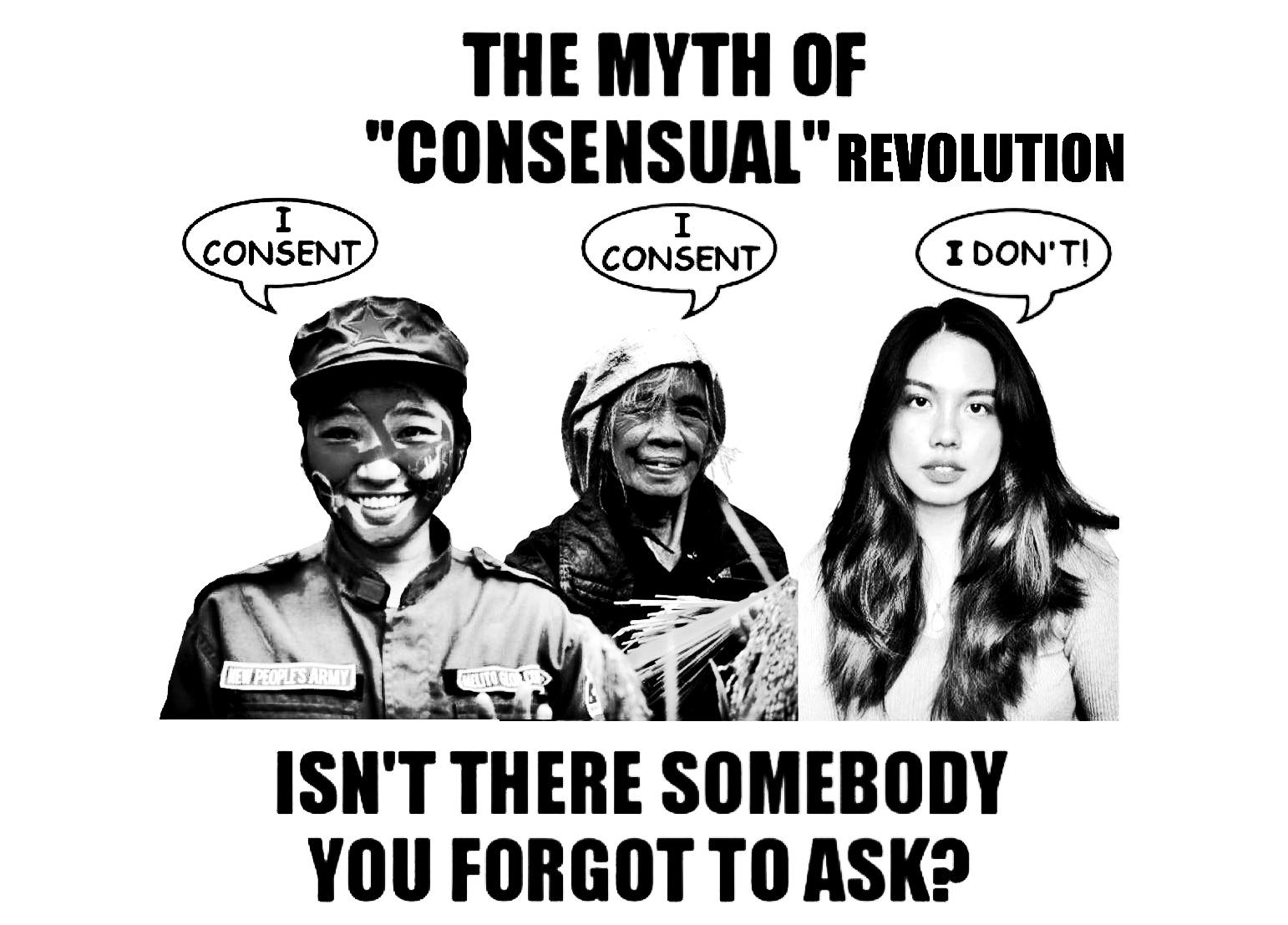
    A Consensual Revolution?

    The self-evident and banal impossibility of such a thing confronts us and laughs, spattering saliva and all, upon our faces. Only the mercenary intelligence of the by-gone Utopian Socialists and today’s decomposing Liberals alike could conjure up such an imaginary. Does the worker consent to the conditions of her life and thus the very same which poses unto her the question of turning over the world in revolution? This is the question Nikka Gaddi poses to her internet e-mass base, and directs to the motley array of revolutionists of our times.

    I. Yesterday

    We find ourselves at the summit of liberal emancipation. The worker is free in two senses: free from the land, and free of property. This freedom, though, has been forced upon her. She has no obligation to the land and to a lord, and she has no property to sell to make a living. What she has is pure, purposive, creative human ability to labor. So when the worker engages in the labor-market, she engages in it as a seller of labor-power. Thus far, none of this has been to her active consent. Torn from the commons by enclosure and statute, her ancestors’ subsistence stripped away so that she might stand “free” before buyers of labor-power, this was the original compulsion that made her a worker in the first place. Then we have a freedom of the herring to be salted.

    Proletarianization is precisely the process of de-subject-ification—i.e., of dehumanization. Where liberal bourgeois society relativizes the ability to consent to the sovereign individual, the human subject as such, the proletarian is definitionally not “human”. For the immutable tablets of Universal Human Rights declare unto bourgeois civilization the ‘right to property’, and whom among us has none? And whom among us counts as Human?

    II. Who counts as Human?

    She finds the Eden of the rights of man, where alone rule Freedom, Equality, Property, Bentham, and enters the marketplace as a legal equal. Having offered up a contract, which she herself cannot pass up else she dies of starvation and cold, trampled by the bustling cities of apathetic urban civilization as a homeless, lifeless body upon the asphalt, she sells her capacity to labor for a day, for a wage.

    So the job offer is sealed and thus her labor-power belongs to another. Inside the factory gates her purposive activity is no longer her own, set to work under rhythms dictated by machinery (her ilk had made to the profitable benefit of her employer) and the ticking clock. Every gesture of the arm, every twitch of the eyebrow is prescribed, fragmented, subordinated to a process she does not control. The products of her hands flow away from her into the warehouse and up into the market. She cannot take part of this of course–she gets paid in cash. So to access the fruits of her labor, the worker clocks out of the factory and dons the social role of the consumer. What the worker’s own hands created confronts her as a thing with its own life, a commodity owned by such a thing as “capital”, having grown from her living labor yet utterly alien to her. “Capital” dictates the rhythm, intensity, and organization of work, and, now as is made self-evident, even of consumption and the conditions of life itself. Wouldn’t you know it, she can’t afford the damn thing! Her own objectified life returns as a power that dominates her very being. The product of her labor acquires a life of its own, and in doing so strips her of authorship over the world.

    So her labor dies. It’s dead. And corpses, not content with “weighing like nightmare” on our brains, do nothing but accumulate, so the products of yesteryear, congealed into machines and money, rise up as “capital”—a self-valorizing process that seems to move by its own volition. Capital purchases raw materials, machinery, and her labor-power (by now no longer purposive human activity as such but “capital” in and of itself), combines them, and conjures forth more value. Now the worker is a living appendage of this dead machinery. Capital’s command—accumulate, accumulate!—dictates the length of her day and the intensity of her toil. She is but a personification of wage-labor—and as far as the employer is concerned, a perfectly interchangeable [disposable] pair of hands. Her desires, her pains, her creative impulses matter only insofar as they can be disciplined into profitability.

    In the completion of dehumanization, the proletarian becomes a living nerve grafted onto a dead body that, vampire-like, drains her life-force of every single drop.

    Driven by the blind compulsion of self-expansion, this system periodically convulses into crises. It produces too much. Actually, she produces too much. The machines stutter and stop. She, having been too productive, is expelled onto the street, joining the “reserve army of labor”. Effectively she is pronounced dead, and the market periodically performs necromancy on that great mass to raise them to the status of undead, zombies haunting the living, threatening other workers by pushing the pressure of wages downward in competition with each other.

    The myth of free contract shatters against the irrationality of a crisis she had no hand in creating. She starves because there is too much food! But “too much” is a relative thing, too, its meaning acquired according to the imperatives of profiteering. So she goes homeless because there are too many homes, becomes a thief because there is too much money, dies because there is too much medicine.

    III. So the dead rise

    Thus far, none of this has been to her active consent.

    Out of this repeated whipping of booms and busts upon her flesh, repeated across millions of lives, whether by the blue moon’s chance or a never-again realignment of the stars, a “necessity” roots into the earth’s crust and forces a crack upon it to bloom in open air. The impossibility of living under these conditions ceases to be a private misfortune and becomes a collective condition. The worker, atomized by competition, is welded together with other workers by this immense suffering and impotence they all share. Even then, this is not to her active consent, but forced upon her by the excruciating pain of the empty stomach boiling in acid, the splitting pain of cracking bones. So the dead rise up, revolting against death. They take up the labor of grave-digging.

    Observing the irreducible suffering of the working people in his time, and the advances in class struggle achieved thus far by history, Marx notes with exceptional clarity: “What the bourgeoisie therefore produces, above all, are its own grave-diggers.”

    Even revolution then is not to her active consent. To escape this world, and in fact to destroy it, to smash it to pieces and burn it to ashes, to leave nothing standing in front of her—this is a most profound need, a world-historic necessity, forced upon her by the radical unfreedom, precisely in bourgeois freedom, that has defined her entire non-existence. The expropriators are expropriated—they must be expropriated. The fetters must be burst asunder. She is delivered into revolution by the full force of her dehumanization.

    Only on the far side of that rupture does the possibility of freedom flicker into being. The working people are forced to make the leap to the ravine, in the rift of the realm of necessity and the realm of freedom.

    IV. Guilty on three counts

    So the liberal pieties about “consent” have been exposed. The solemn ritual of free will hollowed by the dull compulsion of the empty belly. Revolution by a majority vote in the parliament of the champagne-quaffing Socialist Petty-Politicians, the whole sorry carnival, with the interminable functionaries who have never felt the lash of real hunger—notwithstanding the traitorous salt-of-the-earth Labor cretins learned in the ways of machofeudal populism—is the wet dream of a stratum too impotent to imagine its own end except as an extension of its own procedures. Put simply: the working people cannot consent to revolution because they cannot consent to anything at all, insofar as they are, for the foreseeable future, to remain as workers. Proletarians are cattle, definitionally speaking. The root Latin of the word quite literally means ‘offspring’ (or the producer thereof being the sole source of one’s value to society). Consent itself is a category of bourgeois right, the legal form of the isolated monad, and it evaporates at once should we grasp that the subject who would consent is already the product of the very relations she is supposed to overthrow. So far, so good.

    But what of those who, scorning this liberal wet dream, propose instead to make the revolution—to seize history by the throat with the iron will of the Party and the barrel of the gun? Here we encounter the second face of voluntarism, no less idealist for its martial postures, no less trapped in the inversion of materialist understanding for its pretensions to scientific strategy. The consent of the few makes no revolution but a hiking trip toward ranges infested by gun-touting State dogs, foaming with rabies at the mouth at the sight of dead students and journalists and scientists and farmers—leaving nothing behind but corpses martyrized in the pages of Ang Bayan and the smoking ruins of displaced communities. If the liberal imagines revolution as a sign-up form penned by willing individuals, the voluntarist imagines it not really that much differently, as a project executed by The Willing Few—the Party-army and the guerrilla column that replaces the absent class with its own motion and blood. If Nikka sees history as a negotiation among competing blocs of influence, National Democrats see it as raw material to be sculpted by sheer partisan audacity. Despite appearances, both fundamentally agree on the decisive point, which is that revolution is a product of the will. They merely disagree on whose will counts.

    This shared ground is the very foundation of what has been known to the Left as the pathology of activism—the privileging of the motion of struggle itself as the index of revolutionary politics, the frantic assumption that, with enough Action thrown at one’s object, which could be anything, all shall be well, and will transmogrify into qualitative political development regardless of what the objective balance of class forces permits. Activism is the nervous tic of a politics that cannot wait, that cannot bear the immobility imposed by an unfavorable conjuncture, and so fills the void with ceaseless Doing. Its theoretical grounding, voluntarism, is the inversion of the materialist axiom that social being determines consciousness, substituting the overdetermining will of the organized, willing, Consenting minority for the actual development of the capital-labor contradiction as the motor of historical change. And its practical, tactical expression is invariably the adventurist attempt to force revolutionary outcomes through audacious blows when objective conditions do not support them, generating not the awakening of the masses, who remain in their day-jobs and villages watching, often with scorn, yet another self-immolation at the altar of “terrorism” and its impatience, but the exposure of the Consenting to repression and the destruction of organizational capacity that took years to build.

    These three counts are the symptoms of an inability to grasp capitalism as a totality whose contradictions evolve according to determinate laws that constrain what is politically possible at any given moment, and the symptoms make the rot worse. They are the rage of the impotent will.

    The People’s War, we are told, very much unlike the urban adventurists of Manila–Rizal just some decades ago, is a scientifically calibrated strategy, a long march through stages, a patient accumulation of forces that awaits the ripe moment. The guerrilla-liberated zone is the embryo of a new state; the Party-army is the formal expression of political power from the gun. This is voluntarism in its fullest institutional elaboration, and its apparent opposition to adventurism is precisely what makes it lethal as an opportunist rot. For the voluntarist logic is not an accidental excrescence on the PPW; it is demanded by its premises, by the very analysis that claims to ground it.

    What is that analysis? The bankrupt semi-feudal and semi-colonial thesis, by mistaking the specific form of capitalist subsumption in the periphery for a hybrid of modes, writes the proletariat out of the script. The worker is no longer the subject whose very existence as variable-capital, as the living negation of the capital relation, necessitates it to be the grave-digger of the capitalist mode of life, but becomes merely one ragbag of The People to be mobilized, organized, and led under the capacious tent of the Party, who, having formalized the path forward, provides the “socialist perspective” of the petty-bourgeois revolution. But if the Party is not the concentrated expression of a class that is already, in its being, the antithesis of capital, then what is it? It is but a substitute, the few that must make the revolution because the actual movement of the class cannot be trusted to produce it. The Party-army is the world-historical subject, divinely annointed by itself, and Protracted War is simply the form through which the Consenting labors to bring forth a new society from the womb of the old, stillborn and blue as the baby always comes.

    But the gun is not the servant of class power but its surrogate metallic fetish. The “new democracy” that PPW aims to build is a capitalism without compradors, a national capitalism with a red flag, and its historical role is not the abolition of wage-labor but its generalization under a different (crucial: Patriotic!) administrative configuration, and thus a voluntarism swollen into a state developmentalist project, and it is a bureaucracy no less anti-communist for the blood it spills.

    Now comes the objection, half-sob, half-accusation: “But what should we do, then? Just wait? Sit on our hands and let capital grind on while we polish our theoretically pure knobs?”

    This objection only appears compelling, of course, if one has already accepted the voluntarist premise that the only alternative to the National Democratic struggle is the inertia of the impotent sect. But this is precisely what is being contested. The communist response to a society mired in counterrevolution is not to pretend the conjuncture is something else by substituting the Will of the Few for the movement of the class. Nor is it to dissolve the program into opportunism by chasing the majority in conditions where the majority is atomized, passive, and saturated with bourgeois ideology from scalp to sole.

    What militants embedded in the orbit of the CPP-NPA can concretely do is not nothing. It is the same thing communists have always done in conditions that do not permit the direct revolutionary assault: preserve theoretical clarity, refuse to subordinate class politics to interclassist alliance frameworks, work toward organizational forms that correspond to the general interests of the Filipino working class as a global class rather than as a national-popular subject, and above all, resist the catastrophic temptation to treat the party as the class. Keep the knife sharp. But the harder answer, the one that cuts to the bone, is that the CPP-NPA’s theoretical foundations are not errors attached to an otherwise sound communist core. The semi-feudal thesis, the substitutionist logic, the national-democratic horizon are not just tactical mistakes but precisely the direct expression of a voluntarism that can never, by any number and intensity of rectification movements, become the real movement that abolishes the present state of things. The rot of a few apples rots the entire barrel.

    Ultimately both the cretinous Liberal and the gunpowder-headed Maoist are trapped in the same pathetically bourgeois subject-centered metaphysics that cannot grasp the dead-weight of prehistory, the blind autonomized movement of capital that drives toward its own negation without asking anyone’s permission. The working people do not consent to revolution and neither do they manufacture it in the guerrilla base area or the party headquarters. The revolution is forced upon them by the intolerable totality of their own dehumanization, and it is forced upon them with all the violence of a history that has never once consulted them. Only when the realm of necessity is brought under the conscious collective control of the associated producers and the working day is shortened to open the space of free human development—only there can the question of revolutionary “consent” even arise.

    The People’s War is deemed guilty on three counts of Voluntarism, Activism, and Adventurism, and it must be forced to realize this guilt through the baptism of fire. History necessitates it.

    V. The realm of freedom

    We shall not “intend to save” anyone.

    To consent to this life in any full sense is impossible. The conditions of existence are not available as conditions to be accepted or refused; they simply are, the way gravity simply is, and what passes for consent is only the daily reproduction of what has been given.

    Consenting to life is possible only to new people. What propels us is the dead-weight of the human prehistory that is class society unto its end, and we are thus driven to leap by the impossibility of continuing as we are. Communism, the real movement, is “the riddle of history solved”, the leap from the realm of necessity to the realm of freedom.

    Just as against Rome the wild hordes were needed – so that so many and great useful contributions to the organisation of people and things would not be lost – which were unconscious contributors to a much bigger revolution still far away in time, we want the gates of this bourgeois world of profiteers, oppressors and butchers to be struck by a powerful barbaric wave capable of burying this world among itself.

    Amadeo Bordiga. “Forward, Barbarians!” (1951)
  • There Is No Professional-Managerial Class

    There Is No Professional-Managerial Class

    Introduction

    Inasmuch as we can establish a history of ideas throughout the biblically-proportioned tragedy of the American left, the Judas appears as Barbara Ehrenreich (and her husband, John). In their diagnosis of a juvenile, middle-class ‘left’ hopped up on Evil Professional Commodities, they are often credited with the defeat of the new left itself.

    During the days of the American new left (a colossal waste of time, to spare the unacquainted), there was the very obvious reality that they were all ‘middle-class’ lifestylists who were not really getting anywhere with class mobilisation. One could conclude that this is probably down to the obsession Americans hold with their supposedly unique national property (and its rather banal descent from the real position of America as a ‘superpower’ that influences other cultures in its image and cries bloody murder when this doesn’t just produce little Americas), or one could fetishise the ‘middle class’ as the real thing impeding progress.

    Our good friends B&J decided upon the latter, and published a very long Textwall in Radical American that Barbara later conceded was only dry and theoretical to appease “the Marxists”, a tradition to which she claimed her and her husband had adhered to at the time. This makes sense, because the entire thesis is presented as a second-order rationalisation of a mere intuition, that cleverly masquerades as real Truth.

    Inasmuch as you want to know what Barbara thought of her Deviant love for a transient historical instance, you can read her 2013 retro-analysis here. If you want any more revisiting for later historical developments, you might need a Ouija board because Barbara Ehrenreich died in 2022.

    The task of engaging with her Idea now falls to us, the forgotten children of modernity, who must always be couching ourselves in the words of the dead.

    Nevertheless, B&J’s conclusion is remarkably straightforward: that the American middle class is divorced from communist class politics because its essential interest is in management, but not ownership, of capital, and this ‘Professional-Managerial Class’ now deluding itself with an imaginary proletarian status is probably not going to be building any class organisation because it is actually a movement for itself, not class abolition as such.

    This, alike Trotsky’s desperate attempts to assign the Stalinist ‘degenerated workers’ state’ with a ‘class-independent bureaucracy’, is about inventing things to justify priors to keep yourself sane in times of apparent retreat. Unlike Trotsky, B&J are not subtle about doing this, which makes sense in the context of academic culture: something very much in the tradition of trying to say something long enough that it becomes true.

    The spectre of the PMC, regardless of Barbara’s admission of its ‘ruin’ in 2013, has achieved incredible purchase among many self-professed historical materialists, because like all pseudoscience, it sounds intuitively true even if it isn’t. Not even Maoist-Third Worldists are spared the spectre, and indeed it is very helpful for them to conclude that the mechanisms of empire are not down to the need to structure and maintain globalised commodity exchange, but actually empire is the fault of white women in Human Resources. Nowhere is this idea more ascendant than with the American Maoist-Third Worldists, who graciously self-flagellate themselves in an act of penance before the global masses they crackerously oppress with their American Ideas.

    But in a moment of crisis, something curious happens to class politics: the PMC’s oft-touted shackles evaporate, and the working class starts developing notions of organisation. The PMC merely appear as more autonomous proletarians, and we see our managers as idiots just like us who are now having to split ends on their tiny fucking wages to find a shoebox it’s affordable to live in.

    Marx described all this false consciousness and its alleviation way back when and it happens every fucking time like clockwork, but people still cannot retract themselves from their present historical instance, a fetish object so abused it’d instantly kill any psychiatrist it vented to.

    So come the negation of the ghosts, the spectres, and the banshees, and we emerge, like a clearing mist, in our wretched totality: the lucid, living doctrine of our time.

    If B&J’s poltergeist still remains in any substance, let loose the proletarian exorcists, who may banish it for good.

    I

    Let us start with where B&J’s investigation begins.

    Theoretical confusion about class is endemic among all parts of the left. Some leftists (mainly associated with the “new communist movement”) describe students, professionals, and other educated workers as “petty bourgeois,” though more as a put-down than as a defensible analysis. Other contemporary leftists describe all salary and wage workers who do not own the means of production as “working class.” The working class so conceived is a near-universal class, embracing all but the actual capitalists and the classical petty bourgeoisie (i.e., small tradesmen, independent farmers, etc.). But this group, too, finds its definition practically untenable. In practice, and conversationally, these leftists use the terms “working class” and “middle class” with their colloquial connotations, knowing that the distinction is still somehow a useful one. Yet this distinction cannot be pursued in theory: the prevailing theoretical framework insists that all wage earners are working class and that the notion that some workers are “middle class” is a capitalist-inspired delusion.

    EXORCIST’S NOTE: I’m not going to be polite here: this is empiricism. “Having sensed something, the truth is indeed in that sensation.” As someone who is schizophrenic, I presume, the goal here is to convince me that when my imaginary friends make me sense something which isn’t actually ‘real’ to anyone else, I am actually catching a glimpse of true reality. By this ground of epistemic authority, I should be able to change matter itself at will.

    But no, B&J’s imaginary friends are superior to mine, because mine have voices. Only they can change matter with the will of their thoughts, through the cacophonous silence of their skulls.

    In any case, you are not some fucking firebrand radical for recognising that there are people often called ‘middle class’. Marx and Engels did this too, as did almost fucking everyone who talked about class politics because the ‘middle class’ is very demonstrably a real social force, but the point of a Marxist doctrine is to demystify social forces for what they really are. If you start your investigation from the mysticism itself, and not its rational solution in practice, you will do nothing but theology. Again, Marx described this. Marx described it very well. Cast off your saints, he tells us. Face the real world.

    “No,” say B&J. “More saints please!”

    Meanwhile, the rotting pile of dead saints steadily grows.

    This stuff hits a nerve with the American left because at some level they understand there is an ideological barrier whereby they are kind of divorced from ‘reality’, ‘real work’, ‘proper class-consciousness’. They operate under the belief the class leads them, and that they do not lead the class, and in doing so entrench a middle-class mysticism that must apologise for pretensions of a Leninist vanguardism they have not once attempted.

    All understandings like this fucking evaporate when conditions suddenly change, developments these idiots are incapable of taking as anything but supervention, which sometimes develops into the strange American belief that Trump came about as an unknowable infliction of Satan, and not the asymmetrical ladder toward American politics we can historically see him climbing. The American left attempts to address this stupidity with their own stupidity, and ultimately this results in Hasan Piker–a man who, and I cannot stress this enough, will tell you to vote for Jon Ossoff and Graham Platner–calling for a “dictatorship of the proletariat” at Yale.

    This kind of aura-farming is what people do when they abandon politics entirely and become a fandom. We resolve the strength of the movement into Hasan Piker, and if B&J had their way they’d resolve him into the PMC, and resolve the PMC into revolutionary inertia, and thus conclude that we are blind to the developments before our very eyes.

    But B&J are off with God now, so we can instead resolve Hasan Piker into a twitch stream and try not to worry about him too much. The sigh of relief from our Sensitive Communist Youth is palpable; the priests and preachers are not around to gaslight them.

    II

    Descending further into the article–something very careful to attribute qualifications, if-statements, ‘blurred lines’ to its assuredly conclusive analyses, as stating things directly would reveal the futility of the whole exercise–we come across the actual criteria used by B&J for class.

    The Professional-Managerial Class (“PMC”), as we will define it, cannot be considered a stratum of a broader “class” of “workers” because it exists in an objectively antagonistic relationship to another class of wage earners (whom we shall simply call the “working class”). Nor can it be considered to be a “residual” class like the petty bourgeoisie; it is a formation specific to the monopoly stage of capitalism.

    EXORCIST’S NOTE: Take this brief pause to remember these people still, allegedly, considered themselves Marxists when writing this.

    […] if we were going to fully and properly define a Professional-Managerial Class, we would not be able to restrict ourselves to a picture of this group as a sociological entity; we would have to deal, at all stages, with the complementary and mutually interacting developments in the bourgeoisie and the working class […]

    EXORCIST’S NOTE: Indeed, I suppose if you were to fully and properly define a PMC you would have to do all of that. The conclusions you drew would not be historically useful, but they’d make a neat little journal article.

    Anyway, after all of this arse-covering from anyone who would dare assail their saintly intuition, these idiots finally get to the fucking point:

    However, the relation to the economic foundations of society is not sufficient to specify a class as a real social entity. At any moment in its historical development after its earliest, formative period, a class is characterized by a coherent social and cultural existence; members of a class share a common life style, educational background, kinship networks, consumption patterns, work habits, beliefs. These cultural and social patterns cannot be derived in any simple fashion from the concurrently existing relationship to the means of production of the members of the class. […] In addition, the social existence of a group of people is determined not only by its experience at the point of production, but by its experience in private life (mediated especially by kinship relations, which, in turn, are at most only distantly related to evolving relations of production) […]

    EXORCIST’S NOTE: Breathtaking. You see, this kind of ‘modernisation’ is classic because it takes something useful for socialism (an analysis of classes orchestrated around productive relations and their historically-consistent properties) and justifies itself via a deeply perverted transhistoricism into something manifestly useless.

    I would like to remind our Sensitive Communist Youth that lots of academics do this shit too and you are not obliged to necessarily take them seriously because of their institutional authority; I call Communism the real movement that confounds and frustrates academia. But do not be anti-intellectual, either! You only negate these Textwalls in your mind-palace once you have the words to dismiss them. They represent real forces to be studied. Just don’t get caught up in their ideology soup, because Marx gave you a fork, not a spoon. Trying to eat the ideology soup with this fork probably won’t get anywhere and will definitely make you look like an idiot.

    Regardless, let’s stop laughing at these idiots and get into what they’re saying.

    However, the relation to the economic foundations of society is not sufficient to specify a class as a real social entity.

    EXORCIST’S NOTE: When B&J say “economic foundations of society” and “real social entity” they are not referring to historical society, as in, a self-developing system measurable by a doctrine that has a base order it must necessarily fall to in moments of crisis. They are referring to the 20th-Century United States and history’s persistent refusal to produce ‘working-class’ socialists out of thin air, something B&J take to be a development of the left’s attempts to lead the working class, and not the fact the left is fucking terrified of doing precisely that.

    […] a class is characterized by a coherent social and cultural existence; members of a class share a common life style, educational background, kinship networks, consumption patterns, work habits, beliefs.

    EXORCIST’S NOTE: B&J, while acknowledging that a coherent social and cultural existence is preconditioned on relationship to production, very curiously fail to successfully, lucidly explain the procedural relationship between these things. This is because the procedural relationship between reality and ideology is actually incredibly simple on the conceptual level (“spades do not have souls” is probably a logical fallacy or another, but is also self-evidently true to most people), and as such when applied in theory demands a bit of coherent doctrinal practice to make sense.

    As B&J astutely note, the doctrinal practice of the American left is worker-fetishism. They then shrug their shoulders and conclude there is nothing left to do but fetishise another spectre of their historical instance. Where we learn to laugh at the noble savage-adjacent proposal that certain peoples have essential “ways of knowing and being”, the giant pyramid scheme of U.S. intelligentsia is an elaborate sophistry in pursuit of creating a mythology of Americanised ways of knowing and being; that there is something extraordinary about Americans, that Homo Americanus is a new taxonomical category.

    These cultural and social patterns cannot be derived in any simple fashion from the concurrently existing relationship to the means of production of the members of the class.

    EXORCIST’S NOTE: While there is humour in B&J’s admission that they are looking for a “simple fashion” here, i.e. simple answers in lieu of the more painful ones, the Idealism here is particularly stunning because it is effectively admitting a rejection of the Marxist precept that material reality is self-evident and social production is the first use-value of social life. This ‘dogmatic’ assertion, defiant before ‘real history’, is nevertheless laid fairly bare in moments of crisis, but many self-proclaimed Marxists will descend from heaven to the workers here, and tell them they are anything but proletarians.

    Personally, I think what these people do is tantamount to counter-revolution, and the revolutionary history will damn their memories.

    […] the social existence of a group of people is determined not only by its experience at the point of production, but by its experience in private life (mediated especially by kinship relations, which, in turn, are at most only distantly related to evolving relations of production) […]

    EXORCIST’S NOTE: Jaw-droppingly ridiculous. Having returned to the hearth, the homestead, the family, we have a ‘private life’ that is clad in a mysticism so arrogant it borders on gnosticism. Marxist-gnostics believe that the introduction of some unknowable property has occurred over modernity, and that this dark energy, inflicted by the demiurge, is what perverts the perfect world of Saint Marx, God, the LORD.

    So they may now, in an extreme arrogance, claim that ‘kinship relations’ are “at most only distantly related” to ‘evolving relations of production.’ That the relationship between families, which involve making children, and the way you work is now almost irrelevant to this new class. I take it we shouldn’t be giving these people maternity/paternity leave, then, because they’ve actually got a big baby generator that is completely extricated from their lived existence.

    B&J are secretly keeping advanced biotechnology in their home and they are using it to make good professional children at an industrial scale, to eradicate vulgar class-essentialism for good. This is what they must have meant when they said:

    “Services” which had been an indigenous part of working-class culture were edged out by commodities conceived and designed outside of the class.

    Whereas without the blinding light of Barbara Ehrenreich Thought we would have simply concluded this entire sentence is fucking nonsense and commodities don’t actually have souls that are special to the working-class, that working-class life is not a cultural essence but simply the fact some madman has you chained to a production line and will now wring you dry of your surplus value.

    But because we have Barbara Ehrenreich Thought, we can now see clear the materialist truth: these nefarious extraneous commodities are in fact the PMC’s biovats, weaved into existence by ‘kinship’.

    III

    Let’s look at how our poltergeists define their fetish object in relation to their gnosticism.

    We define the Professional-Managerial Class as consisting of salaried mental workers who do not own the means of production and whose major function in the social division of labor may be described broadly as the reproduction of capitalist culture and capitalist class relations.

    EXORCIST’S NOTE: Any basic understanding of Marx’s critique of political economy readily presents us with the fact that ‘salaries’, for one, are merely labour-power purchased either in advance or in bulk. Any attempt to divorce this from a wage relation is a return to mysticism.

    We know that wage-labour is alienating, that professionals and managers can and do experience sadness, burnout, ennui, et cetera because they are not capitalist Stakhanovites they are human beings with emotions.

    We know, then, that even if the job of the manager is the ‘reproduction of capitalist culture’ through ‘mental labour’ (the vagaries of the text yet again doing heavy lifting with their inability to say anything of substance), the class-interest of the manager, assuming their relationship to production is ultimately the same as their workers, is ultimately determined in the direction of social-revolution; that they appear less likely to do this is explained through their autonomy within and management over facets of civil society in much the same way you would a cop or professional soldier.

    Just because the ‘PMC’ will frequently act like pernicious petty-bourgeois fascists does not, in truth, mean they necessarily are; you know, Daniel Craig is not literally James Bond. The initial structure incentivises behaviour distinct from real interest. The Marxist says professionals are probably stepping on a rake here, the Marxist is ignored, and when all the professional jobs are evaporated by a crisis, the Marxist is proven correct. The idealists, for their part, probably believe this unforeseeable crisis to be alike Noah’s Ark, and sent by God.

    I remind our Sensitive Communist Youth that these people may sound very confident in what they say; it does not make them any less fucking wrong.

    The PMC, by our definition, includes people with a wide range of occupations, skills, income levels, power and prestige. The boundaries separating it from the ruling class above and the working class below are fuzzy.

    EXORCIST’S NOTE: Yes, it is hard to give shape to a ghost.

    Second, occupation is not the sole determinant of class (nor even the sole determinant of the relation to the means of production).

    EXORCIST’S NOTE: Qualifiers like this appear quite a lot in the text, where B&J will re-iterate their positions as if it makes the analysis any less useless. This axiom in particular (what they’re saying is that the way you make money is not the determinant of your relationship to production; it’s actually some other, shady thing, “kinship relations”, “PMC culture”, all now self-developing things) is basically a reminder that their whole Textwall is entirely predicated upon a notion of a self-developing family largely alien from production.

    The positive Marxist writes for the peaceful times, when nothing much seems to happen (things do happen, they just aren’t socialism); this makes their theory a comfy opiate for disillusioned socialists, and a complete liability when the times run sour. It’s religion.

    […] the relationship between the bourgeoisie and the proletariat has developed to the point that a class specializing in the reproduction of capitalist class relationships becomes a necessity to the capitalist class. That is, the maintenance of order can no longer be left to episodic police violence.

    EXORCIST’S NOTE: Even though I’ve already read this Textwall, I really spat out my beer when i re-read this bit.

    “A class specialising in the reproduction of capitalist class relationships” is just one of many sentences of pure air that B&J assail us with, but what’s so funny about it is they think people can consciously specialise in generality and have this be a class-basis, no less; that these people are trained by the witch doctors of capital to think hard enough that they can control the masses better than any cop.

    Here we must ignore the episodic police violence that has been going on since America’s inception, and generally forms the line of order when this psychotronica fails.

    The penetration of working-class life by commodities required and continues to require a massive job of education — from schools, advertisers, social workers, domestic scientists, “experts” in child rearing, etc, […]

    EXORCIST’S NOTE: This is where the professional psychics are actually presented in evidence, that the aforementioned tainted, ‘professional’ commodities through distinct ‘professional’ services are done through ‘professional’ education. This fetishised mental labour is presumably what confers upon the commodities their ‘professional’ stamp. By managing capital in a very banal sense, at some point, the ‘PMC’ has learned to contort the soul and shape of the commodity itself.

    Because, as B&J remind us consistently, the ‘PMC’ has no good beginning or end point and is not coterminous with any real and defined boundary in evidence, we also can’t actually find a definite grouping of people who are contorting the precious working-class commodities.

    We can conclude, then, commodities are contorting themselves, folding gelatinously over each other, and the ‘PMC’ is spat out of all this.

    Or we can dismiss this fad as it passed us by.

    Thus the relationship between the PMC and the working class is objectively antagonistic. The functions and interests of the two classes are not merely different; they are mutually contradictory. True, both groups are forced to sell their labor power to the capitalist class; both are necessary to the productive process under capitalism; and they share an antagonistic relation to the capitalist class. (We will return to this point in more detail later.) But these commonalities should not distract us from the fact that the professional-managerial workers exist, as a mass grouping in monopoly capitalist society, only by virtue of the expropriation of the skills and culture once indigenous to the working class.

    EXORCIST’S NOTE: Here, again, we see depicted an ‘expropriation’ of the (American) working class’ ways of knowing and being. What the B&J are describing here is that yes, the working class in America did certain jobs that are now professionalised. This fairly useful observation is transformed into a weapon of the bourgeoisie when B&J say the commodity-spirit has been perverted by insidious professional-managers.

    But for me, as a traditional wage-labourer (albeit British, so perhaps Homo Americanus simply eludes me through a failure to conceive of its higher consciousness), I am somewhat uncertain as to what this professionalisation means in relation to my class-interest other than the introduction of some more petty tyrants (something my life is already in abundance of). B&J tell me that it’s actually a warping of the traditional wayfaring established and passed down to me by my worker ancestors, carried down a ley line of wisdom via an indigenous oral tradition.

    One forgets we’re reading something produced by people who consider themselves ‘Marxists’–it comes across as little more than Volkisch mysticism.

    We should add, at this point, that the antagonism between the PMC and the working class does not exist only in the abstract realm of “objective” relations, of course. Real-life contacts between the two classes express directly, if sometimes benignly, the relation of control which is at the heart of the PMC – working-class relation: teacher and student (or parent), manager and worker, social worker and client, etc. The subjective dimension of these contacts is a complex mixture of hostility and deference on the part of working-class people, conterapt and paternalism on the part of the PMC.

    EXORCIST’S NOTE: Here, the teachers and students, managers and workers, social workers and clients, etc. are taken as antagonistic to each other not because it’s annoying when some idiot tells you what you ought do, but because the middle class professionals are annoyances in themselves. The means of transfer (the social relationship) are disregarded here for being inconvenient to the project of American leftist self-flagellation.

    We can talk all we want about why the middle class is so fucking annoying, and we’d basically be performing Hermeticist divinations because ‘annoyance’ isn’t a historical thing. The fact that I find the middle class annoying is probably not the engine of history, it’s more likely the social relations which presaged our meeting in the first place.

    The classical petty bourgeoisie lies outside the polarity of labor and capital. (It is made up of people who are neither employed by capital nor themselves employers of labor to any significant extent.)

    EXORCIST’S NOTE: Here we kind of see part of this modernisation’s fatal flaw–a disconnect from Marx’s Theses on Feuerbach, which by all accounts are the base instructions for Marxist doctrinalism and the order from which positive Marxism must stray at some point.

    When you have decided that ‘labour and capital’ itself is a polarity in contradiction; that labour is something itself employed, that capital is something that itself employs, and take this as an article of faith rather than a rhetorical flourish, you have essentially made a capitalist and a proletarian essence that can be transposed between individuals rather than studying these essences as they exist: an ensemble of the social relations.

    The fact is that labour and capital, in their real forms under capitalist production, are measured in social relations. Form-fetishism, of treating labour and capital as anything but this, is among the highest defects of positive Marxism; of using the language Marx used, but with the bourgeois definition of this language; that the ‘capital’ and ‘labour’ he spoke of are not used in the context of their real doctrine but are projections into the future, where bourgeois economists for the most part take them as things-in-themselves.

    To descend to Earth with this understanding, labour is not a quantity instructed by capital, but the life that is lived for workers, that their real life is robbed from them by alienation, that capitalist labour is not labour, that exchange is a social property that you nevertheless experience in a real sense; that capital itself is the mere social relation of domination expressed in money and commodities, which, once fetishised, may generate a system of political economy that understands itself and only itself, and as such cannot fit the missing part (real labour) into the equation.

    The petty-bourgeoisie employs its own labour and is employed by its own capital and as such is directly related to the ‘polarity’ of labour and capital because it is operating in a system of exchange with capital accumulation concentrating in monopoly; something we all know is bad for small businesses!

    Where us Marxists applaud the cruel and iron hand of capital for sweeping these Hitlers from their pedestals, we do so with a wink: you’re stuck with us now, mom and pop! And as capital’s iconoclasm sweeps the saints from our walls, we may one day look upwards, in lieu of anything else, and decide that there still remains one more God to be tossed from heaven.

    In this understanding, we can apply a self-sealing logic that might get us somewhere. Or we could chase ghosts, in rapt allegiance to the shepherds of the coming crisis.

    IV

    Now, finally, we should talk about the fetish object’s historicisation by our poltergeists.

    It is mostly a decent history, of course, somewhat cheapened by the non-existence of its subject matter; but there are a few things to contend.

    But the conflict between the PMC and the capitalist class went deeper than the issue of occupational autonomy. Early PMC leaders envisioned a technocratic transformation of society in which all aspects of life would be “rationalized” according to expert knowledge.

    EXORCIST’S NOTE: B&J tell us that the PMC is antagonistic to the capitalist class. They then tell us that this cause lies in factors other than value extraction, that actually the raw ideas and visions of the classes are, in fact, the engine of class struggle, and not the class’ real existence, which derives itself from things other than the essential soul of that class’ ideology.

    These idiots unironically think that there is a klassengeist then articulated, rather than identifying the klassengeist as a spectre of the articulation itself. In doing so they perform a sort of deranged mysticism that actually posits civic technocracy as an interest in itself, rather than an infliction of positive interests. This entire ‘PMC’ is built on the corpses of saints.

    Specialization was the PMC member’s chief selling point, the quality which justified his or her claim to a unique niche in society, but it acted as a centrifugal force on the class as a whole.

    EXORCIST’S NOTE: This Deviant fetishisation of the PMC has thus allowed B&J to take ‘the class as a whole’ as something acted upon by its Essences, and through clever sophistry present this as its real Essence. The problem is that the class they have identified, established, and defined, is not actually a product of any Essences but a matter of autonomy under capital.

    The endeavour to do anything other than chase ghosts is the logical conclusion of any positive Marxism.

    Conclusion

    The ‘PMC’ mythology was useful for as long as the ‘PMC’ existed. Now it doesn’t exist, we are left with ghosts.

    I do not preclude the notion that B&J were trying to answer the questions of their time. The problem lies in how this extends beyond their time; that the postponement of revolution is often invoked by the moral authority of a spectre which no longer exists.

    If we try and analyse doctrines in relation to our real situation in the here and now, we are disturbing saints; that their positive, bastardising shibboleths do not extend to today. Take their opinion on ‘unproductivity’; that the ‘PMC’ is unproductive because it is not producing ‘real’ commodities.

    The main crux of B&J’s theory is the ridiculous notion that the experience of professional work is heterogenous, and its occupations do not cohere people in the same fashion as conventional wage labourers. The ability to navigate the ‘PMC’ stratum is depicted as a matter of familial networking, of background, of lifestyle—the occupation is contextually important, but it is not what solely defines their class.

    This idiosyncrasy falls back on itself when you then ask the question: so how does one become PMC? The response from this theory is necessarily incoherent, dependent on a totality of factors of which profession is important but not the whole story, that it depends on who your parents are and who you know and how you live your life and whatnot, all flattened by the ‘condition’ of an ‘essentially nonproductive’ professional class.

    The idea that ‘production’ can be social, and not immediate, is completely beyond this frame of reference.

    We ought move beyond this nonsense, and truly regard the real conditions of our time.

    And for that, I do not think we ought return to the provincial invocations of B&J Ehrenreich.
  • Theses on Textwalling (What’s Our Deal)

    Theses on Textwalling (What’s Our Deal)

    I

    The chief defect of all presently existing Marxism – that of the ICP included – is that the thing, reality, articulation, is conceived only in the form of the Textwall, but not as Textwalls that make sense to people, not subjectively. Hence, in contradistinction to organisation, the active side was developed abstractly by Textwalls – which, of course, does not know real, articulate activity as such.

    The Communist Left wants conceptual Textwalls, really distinct from the objectified concept, but it does not conceive Textwalling itself as objective activity. Hence, in their Textwalls, they regard the Textwalling attitude as the only genuinely human attitude, while practice is conceived and fixed only in its dirty-judaical manifestation. Hence it does not grasp the significance of “polemic”, of “simplifying”, activity.

    II

    The question whether objective truth can be attributed to Textwalling is not a question of theory but is a practical question. Marxists must prove the truth — i.e. the reality and power, the this-sidedness of their thinking in practice. The dispute over the reality or non-reality of Textwalling that is isolated from practice is a purely theoretical question.

    III

    The materialist doctrine concerning the changing of circumstances and upbringing forgets that circumstances are developed by Marxists and that it is essential to Textwall at the Textwaller themself. This doctrine must, therefore, divide Marxism into two parts, one of which is superior to Marxism.

    The coincidence of the changing of circumstances and of human activity or self-changing can be conceived and rationally Textwalled only as revolutionary practice.

    IV

    The Communist Left starts out from the fact of Marxist doctrinalism, of the duplication of the doctrine into a falsified doctrine and an authentic one. Its work consists in resolving the falsified doctrine into its authentic basis.

    But that the authentic basis detaches itself from itself and establishes itself as an independent realm in the clouds can only be explained by the cleavages and self-contradictions within this authentic basis. The latter must, therefore, in itself be both understood in its contradiction and revolutionized in practice. Thus, for instance, after the authentic invariant is discovered to be the secret of the falsified doctrine, the former must then itself be developed in theory and in practice.

    V

    Self-described ‘Marxists’, not satisfied with abstract Textwalling, want organisation; but they do not conceive Textwalling as practical, human-organised activity.

    VI

    These Marxists resolve the falsified doctrine into the authentic doctrine. But the authentic doctrine is no abstraction inherent in each single Marxist.

    In its reality it is the ensemble of the social Textwalls.

    These Marxists, who do not enter upon a criticism of this real Textwall, is consequently compelled:

    1. To abstract from the historical Textwall and to fix the falsifying sentiment as something by itself and to presuppose an abstract – isolated – Marxist individual.
    2. Doctrinal understanding, therefore, can be comprehended only as “the wordcel”, as an internal, dumb generality which naturally unites the many Marxists.

    VII

    These Marxists, consequently, do not see that the “falsified doctrine” is itself a product of the doctrine, and that the abstract Marxist who they analyze belongs to a particular form of it (its falsification).

    VIII

    All Textwalling is essentially practical. All ideology which leads Textwalling to Idealism finds its rational negation in Marxist practice and in the comprehension of this practice.

    VIX

    The highest point reached by the present aspiration to a self-sealing Textwall, that is, Marxism which does not comprehend Textwalling as practical activity, is contemplation of single Marxists and of positive Marxism in general.

    X

    The standpoint of the old Marxism is authentic doctrinalism; the standpoint of the new is Marxist society, or social Marxism.

    XI

    The Textwallers have only developed the doctrine, in various Marxists.org portals; the point is to explain it.

    ADDENDUM: Jokes aside, the point is to just argue for Real left-communism, but in a convincing rather than analytical fashion. Polemics, etc.