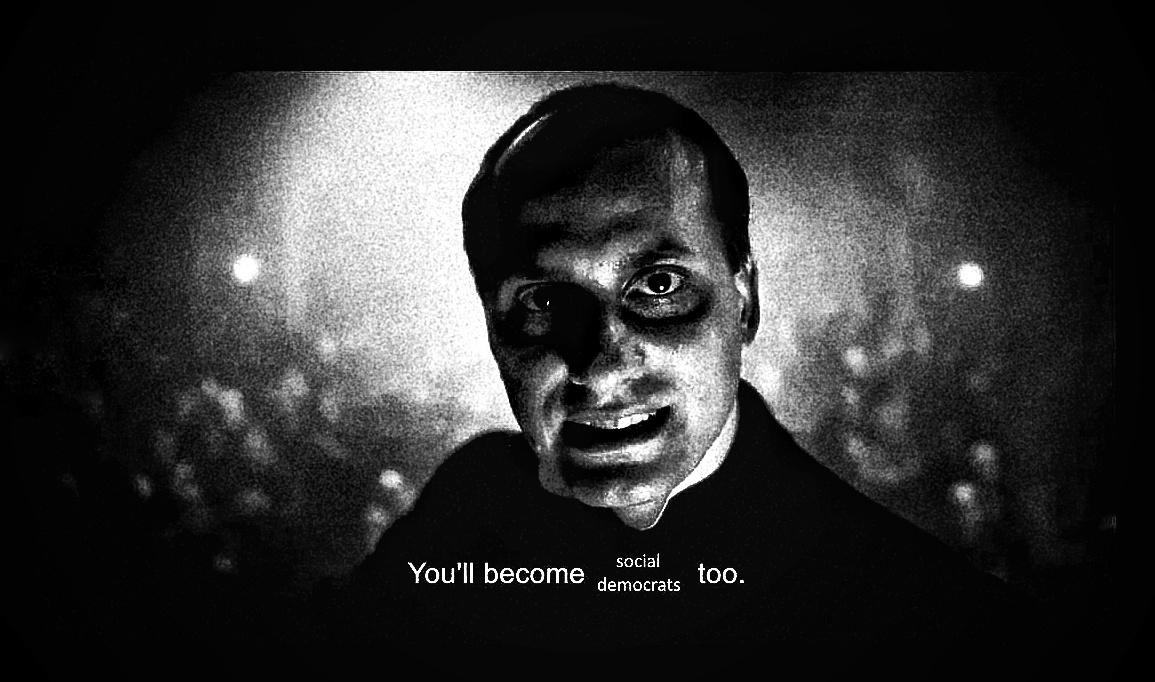
Kontra-sokdem
The principle of the historical invariance of doctrines which reflect the tasks of protagonist classes, and also all the potent referring back to founding principles, stands opposed to the gossipy assumption that every generation and every season of intellectual fashion is more powerful than the previous one. It rejects the whole silly film show which portrays the relentless advance of civil progress, and other such bourgeois prejudices from which very few of those who lay claim to the adjective “Marxist” are really free. It is a principle which applies to every great historical period.
ICP. The Historical Invariance of Marxism.
Yesterday
Social Democracy was born blue. If one wishes to trace the putrefaction of the socialist movement back to its first act of betrayal, one need only stand at the threshold of August 1914 and take in the stench of the German Social Democratic Party voting for war credits. In the sublime of parliamentary prostitution, the entire tradition of pretended proletarian politics immolated itself on the altar of national chauvinism, and the smoke that rose from the burnt offering was thick with the rhetoric of “lesser evils”, “national defense”, and the eternal immaturity of conditions.
It was the culmination of decades during which the party of Bebel, Liebknecht, and Luxemburg had become a well-oiled apparatus for administering capitalism under the incantatory headmast of socialism, its midwives the humble revisionist Bernstein and the unctuous center-keeper Kautsky, men who transmogrified Marxism into a quasi-progressive Church of good manners and trade-union accounts. The movement that had once declared that the emancipation of the working class must be the work of the working class itself had, by bureaucratic mitosis, produced a leadership with a credo that the realization of socialism on earth must be subsidized by the bourgeoisie.
Social Democracy blossoms into its own florid and farcical blooms in the Philippine tropics. Two in particular, conjoined twins born from the same, each accusing the other of being counterfeit (cf. CPP: “Akbayan is pseudo-leftist”), while both replicate with the faith of a provincial imitator their decomposed European ancestors.
On one side, we have the citizen-politicians of Akbayan, who, having emerged from the wreckage of the Maoist Communist Party’s renegade faction in the 1990s, openly genuflect before the ballot box, spouting the pieties of “democratic socialism” which, stripped of its pleasant upholstery, means nothing more than administering neoliberal austerity with a human face and a well-remunerated NGO sector. Their project is thorough honest whoredom to the electoral circus so transparent in its class collaboration that one almost admires the candor with which they substitute class struggle with focus-group-tested platitudes about “inclusive growth” and “social accountability”, as though the problem with the dictatorship of the bourgeoisie is that it has not been sufficiently accountable to its subjects.
On the left side of the isle is the National Democratic movement, that lumbering beast of dog-eared copies of On Protracted War and stale united-front hagiology, which imagines itself the revolutionary alternative because it wears a uniform and carries a gun. The National Democratic Front—and its puppet-master Communist Party—has perfected the insurrectionary aestheticization of Social Democracy. They pursue a “national democratic revolution”, theoretically the spiritual continuation of the aborted Katipunan revolution, that, in its obsessive staging of tactical alliances with any disgruntled landlord or provincial warmonger who can mutter patriotic anti-imperialist slogans, remain tailing the national bourgeoisie, becoming its pressure group in the hills and, when the political winds shift, its emissaries at the peace table. Their armed struggle functionally becomes a bargaining chip for what they project to be eventual coalition governments, betraying a long historical record of failure from Macapagal to Duterte, and “genuine” agrarian reform that preserves private property in land, all while humming an off-key Internationale into the humid night.
The NDF and Akbayan despise each other with the special venom reserved for rivals fighting over the same swill; the former scorns the latter’s parliamentarist naivete, while the latter scorns the former’s out-of-date militarism. For communists, it has always been clear that they are opportunist species of the same genus that feeds on the carcass of revolutionary possibility, one through the electoral road and the other through the chimeric people’s war. Together, they form a social-democratic archipelago in civil war.
The German revisionists of 1914 offered the Kaiser their patriotic bodies; the Filipino opportunists of the 21st century offer the capitalist state their bodies electoral and ballistic. The humidity accelerates the rot.
Today
And when one points out these obscenities, the cry goes up from both camps: “Purists! Dogmatists! Ultra-leftists! Sectarians!” It is the universal squawk of the opportunist confronted with the revulsion of the principled, a word-spell to exorcise the specter of class truth by diagnosing it a psychopathology. Palatino, struck with creative inspiration, would call the Left critics of the Villar-BAYAN situation in 2010 as “ambitious apostates” and “fundamentalist freaks”. In reality, their accusations of purism is no more than bourgeois phrasemongering that performs the neat trick of dismissing any consistent proletarian partisanship as a personality disorder. As any good socialist knows, cooperating with the ruling classes is simply hard-headed realism forced upon us by le material conditions, which is basically Marxist materialism, or whatever.
Ironically enough the charge of “dogmatism” is itself the most guilty dogma of counter-revolutionary leftism. Dogmatism is a talisman brandished against anyone who reminds them that the proletariat has interests irreconcilable with those of the bourgeoisie and its satraps. What, after all, does our saintly “anti-purist” actually mean when he prates about the danger of isolation and the necessity of “broad unity”? He simply means that the proletarian movement must put itself under the hydraulic press of the bourgeoisie to prove its willing pacifism and harmlessness, that it must mutilate its demands, purge its memory of the Spartacist Uprising and the Cultural Revolution, and learn the cuckolded language of policy proposals and transitional demands all so that the functionaries may sit at tables with the powerful and feel the warm glow of being taken seriously.
But after Marxism had ousted all the more or less integral doctrines hostile to it, the tendencies expressed in those doctrines began to seek other channels. The forms and causes of the struggle changed, but the struggle continued. Pre-Marxist socialism has been defeated. It is continuing the struggle, no longer on its own independent ground, but on the general ground of Marxism, as revisionism (…) And it patently follows from the very nature of this [revisionist] policy that it may assume an infinite variety of forms, and that every more or less “new” question, every more or less unexpected and unforeseen turn of events, even though it change the basic line of development only to an insignificant degree and only for the briefest period, will always inevitably give rise to one variety of revisionism or another. The inevitability of revisionism is determined by its class roots in modern society. Revisionism is an international phenomenon (…) [So is] “revisionism from the left”.
VI Lenin. Marxism and Revisionism.
One might recall the 2010 dissenter movement within the Maoist Party cohering around the outlet Bulatlatan to polemicize against the Party’s decision to endorse and campaign with the Villar–Marcos tandem; or the 2012 debacle between Akbayan, who was in too deep with the Aquino government, and Anakbayan, who represented in that lightning rally the National Democrat partylists; or the 2016 situation between the butcher Duterte and the all-too-eager CPP–NDF. Just how utterly, inanely pathetic is it, as self-professed socialists, to bicker over who is the Real Partylist™ to be rightfully recognized by the bourgeois state?
Despite the defeats incurred by sequences of the left throwing itself off a cliff via electoral and activist opportunism, our socialist petty-politicians insist that the next attempt will be different. Meanwhile, stating what is an a posteriori derivation, that is, do not throw yourself off a fucking cliff or you will break bones including your skull, is apparently the naive, puritan, doctrinaire, dogmatic conclusion. But maybe gravity doesn’t apply in a semi-feudal, semi-colonial society.
Social Democracy is characterized by a remarkable arrogance that it always finds within itself the means to manipulate the material of the State and of capitalist society generally as it freely wishes without permanently staining its hands with blood. The common kernel of all Social Democratic movements today as it was in history, from Noske and Lassalle to Stalin and Mao to Gramsci and today’s Neokauts is that class society, barring the nebulous impression of “present material conditions” (i.e., the electoral prospects), is an open field of maneuver where one can do what one pleases. This of course runs into the immediate problem posed by Social Democrats when convenient of the “need to learn from history”, by which they mean Trump won because the stubborn puritan party of the Communists, comprised of about 20 people maximum in the US, did not vote for Harris, and so Communists must always “vote blue no matter who”. Today, Akbayan lauds the butcher Gibo Teodoro for genuinely no good reason whatsoever, exclaims our friends at the Left isle. We agree in principle in condemning any praise for butchers and lackeys of the murderous state, and we add: it doesn’t need a good reason is the reason; it is an openly Social Democratic party; opportunism outnumbers the platelets in its blood. It would be like asking ice cream to stop melting. The ND Left can get away with calling out Akbayan because it does not admit even to itself that it too is a Social Democratic movement, and thus also an opportunist’s nest. If (or when) tomorrow the ND Left once more finds its pet warlord or neoliberal girlboss to collar itself to, we shall hear the same excuses from its constituents as we today are forced to endure from Akbayan’s.
Akbayan merely shows the ND Left its future.
If our petty socialists were serious about self-criticism, they would be Communists! But obviously, self-criticism is also purism, dogmatism, doctrinaire, a ridiculous ask for activists under heavy fire—and activists are never not under heavy fire. What is to criticize? Nothing and everything. More pointedly: what is the measurement for criticism? The common yardstick to both is the democratic principle. This causes major confusion among vacillating activists and the most forward-looking elements of the youth and the working class, because democracy is supposed to be a universal good, an ideal always to be desired, and yet the Democratic Left is at odds with itself for not embodying enough True Democracy. So each side’s criticism of the other fails at the outset. Akbayan criticizes the National Democratic Left for not condemning the NPA, well, what the hell are you expecting? The NPA is the National Democratic revolution! On the other hand the ND Left criticizes Akbayan for “being a fake partylist”, when it has its own mass constituency across classes and sectors that it claims to represent, from women to workers. How does this criticism stand? Apparently because only the ND partylists are the real partylists, and thus they go self-flagellating in front of the democratic bourgeois State, citing like good and responsible republican citizens the democratic Constitution—which as we all know is a highly respected document by the bourgeois itself—in begging for this rightful recognition.
As I have written elsewhere, the democratic fetish of Maoists and Akbayanites…
treat democracy as a neutral indeterminate political form that can be tactically occupied and progressively transformed in the direction of communism and “service of the revolution”. Here democracy is instrumentalizable; provisional demands that expand political space, weaken repression, and enable proletarian self-organization, which will later overload the democratic shell and culminate in revolutionary rupture. But in truth what this does service to is the abstraction of democracy from its historical constitution and social function. (…) Democracy operates through abstraction. Its universality is achieved only by suppressing determinate social antagonisms and presenting individuals as formally equal bearers of rights and votes. (…) Class antagonism cannot appear within the democratic form as antagonism without destabilizing the form itself. Democracy is an identity-form that symbolically reconciles material contradictions innate to capitalist society, and neutralizes non-identity in the process of dissolving class antagonism into formal equality. Thus the proletariat ceases to appear as a class confronting capital, but becomes a demographic, if internally differentiated, aggregate whose interests are to be represented and managed in the State.
Fragments on Invariance.
But it is implicitly understood that self-criticism is only for convenient times, that is, when each can claim that they are the Party of Self-criticism.
In a society cleft by class, groaning under the weight of its own antagonisms, there is no such thing as purity in the abstract, only partisanship in the concrete. Under class society, the only partisanship which really exists is class partisanship.
In class society there is no view from nowhere.
To be a “purist” is simply to refuse to step into the same sewer as those who would have the workers pay with their blood for a program of class reconciliation. When the Akbayan petty-politico swoons over muh evidence-based policy and le constructive engagement, he is in fact swooning over the maintenance of exploitation and the prison complex of parliamentarism; while as the ND cadre waxes poetic about a historic bloc against imperialism, he is melting the revolution into a gelatinous puddle where communism is dissolved into the interests of the legendary unicorn that is the national bourgeoisie. Despite their mutual bickerings both are at least in complete agreement that the proletariat is too weak to trust its own praxis, and that it must forever be chaperoned by its social betters, i.e., the ever-benevolent, educated, samaritan, democratic petty-bourgeoisie.
“Purism” and “dogmatism” are, then, nothing but the phantom names for the terrifying idea that the working class might set itself in motion without permission from the middle-class activist-managers and the commissars of the people’s war. We are accused of fighting a phantom, but it is the anti-purists who inhabit a spectral world in which classes can be reconciled through dialogic magic.
Talk about religious psychosis!
Tomorrow
Our Great Elector is the rifle in the hands of the insurgent worker, who does not dream of depositing a paper ballot but of striking the enemy.
ICP. The Trotsky Question.
From the position our good friends so cavalierly deride as “purist” we report back with cheer: the class must amputate this carcinogenic limb of opportunist cretinism or it will die of tetanus.
The proletariat is an organism perpetually assaulted by fevers and viral infiltrations, each a syndrome of immunological compromise that persuades the body to attack its own revolutionary antibodies as foreign invaders. When Akbayan preaches the sweet reasonableness of incremental reform, it introduces a toxin that sedates the class into believing that capital can be negotiated with and that the revolution is itself the slow rearrangement of parliamentary seating; its entire practice is a prolonged suicide note written in the prose of economic conferences and civil society workshops where former student radicals and veteran ex-cadre learn to say “stakeholder engagement” without vomiting. When the National Democratic movement, on the other hand, sends its cadres to organize peasant communities around petty-bourgeois “land-to-the-tiller” programs that leave the structure of wage-labor and local usury intact, it introduces a revolution that is at once its counter-revolution. Social Democracy is the antibody of the Party of Order, policing the proletarian body so that it never quite develops the fevers necessary to expel the parasite of bourgeois ideology entirely.
The “dogmatist” who still clutches the threadbare texts of Marx, Engels, Lenin and the milieu of the Marxist Left observes all this and understands that the fight against opportunism is not a pedantic quarrel over who is the Real Partylist™ but a literal fight for the life of a class against the amnesiac forces of decomposition. The immunocompromised proletariat, dizzy with the infections of electoralism and activism, can only regain its health by a ruthless course of political antibiotics: the wholesale liquidation of every program that subordinates the independent movement of the proletariat to the interests of any other class.
What Akbayan and the NDF call the “purist” terror is, in truth, the basic hygienic reflex of a class that must break every tie with the bourgeoisie, its state, its legality, its nationalism, its compromises, and its sentimental attachment to spectacle. There is no happy communion table where the Communist and the Social-Democrat may break bread, no blended theology where “tactical flexibility” justifies the poisoning of the well. The historical party of the Communists expels the program and outlook of Social Democracy in all its forms as biophysical waste.
A new doctrine cannot appear at just any historical moment. There are given, very characteristic – and also very rare – periods in history when, like a dazzling beam of light, one can appear; and if the crucial moment is not recognised and the terrible light not faced, it is no good resorting to little candles instead; by which the way is lit for academic pedants and fighters of little faith.
ICP. The Historical Invariance of Marxism.
We in the Communist Left have always held steadfast to the necessity of the truth that the working class constitutes itself as a political subject on its own terrain, with its own world-historical interests—not in the antechambers of the bourgeoisie but against them, not within the courts of civilization but outside civilization, as the barbaric forces, to paraphrase Fanon, which will take history into its own hands and swarm into the forbidden cities.
Unlike the Dutertistas who mourn, we shall welcome the exercise of dictatorial democracy at the hands of the bourgeoisie, who everywhere creates the conditions for its overthrow in spite of itself. The various Democratic movements of the pseudo-proletarian milieu, from Social to National, have exhausted themselves in the last two centuries. We will sing and dance at its funeral at the hands of the insurgent, Communist proletariat.
Against them, we reassert, with the full splenetic force of those who have watched the proletarian movement die a thousand deaths from the inside, that the organism must be purged and the class truth screamed in their faces until their entire edifice of shamefaced collaboration collapses under the weight of its own cynicism. As a comrade once said, this persistent malady of the workers’ movement can only be treated with a classic kick in the ass.