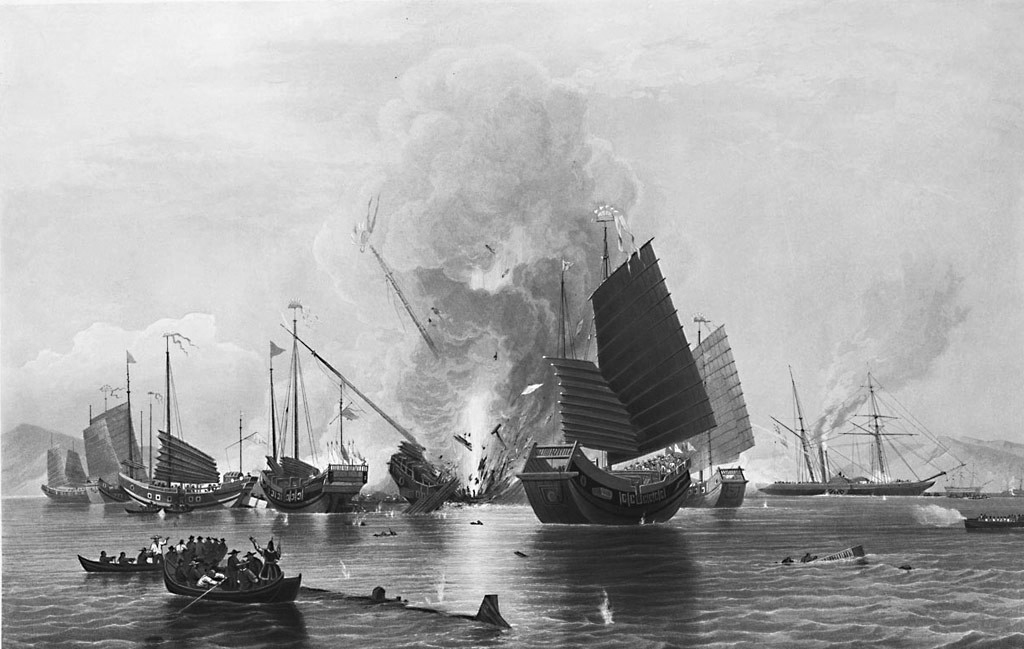
During the 19th Century, the corrupt Jurchen hegemony of the Qing dynasty dominated China, and its venal and parasitic leadership made very clear that China ought remain a place where not much happened, where their splendid supremacy over all foreign barbarity found itself in perfect evidence, the borders would remain welded shut, trade would be minimal, and all relationships beyond the imperial borders would go no farther than the establishment of tributaries.
All under heaven, as far as the imperial hierarchy was concerned, relied upon this way of things. The introduction of conflicting factors could destroy the norms which had governed China for countless generations. It was on these grounds that China stood firm, and would continue to stand firm. To reform the country would introduce new types of people, and those types of people, doubtless more dynamic than the strict and myopic bureaucracy, would take precedence in the long run. This could not be allowed! Otherwise, China would be a step closer to being ruled on merit rather than tradition. Horrifying!
But reform would arrive anyway.
When the British attempted to convince the Qing Emperor to open trade to the west, he correctly deduced they were swindling devils who could not be trusted and as such refused. But his critical error was in the assumption that the British were unable to impose themselves by force. The Chinese simply couldn’t conceive of a world that didn’t center China, a natural center. The Qing Emperor treated the British as barbarians offering tribute, and gracelessly declined any ‘equal exchange’ with the foreign devils.
The British, of course, who had proven in India to be rather enterprising indeed, viewed the world as something largely acquired through the supremacy of its gun-toting steamships.
There was no ‘moral depravity’ to which British capital would not stoop. Honour was a relic of the past, of the Anglo-Saxon impulse, the desire of Alfred the Great to unify a fractured petty kingdom to defend against a horde of foreign invaders. British capital was profoundly Norman in its sensibilities, however; the rule of the deed, of seizing what you want, and in the process laying the foundations for a rootless international hierarchy even beneath the auspices of an ostensible ‘nationalism’, as it arose.
Honour lay dead, alongside the Cavaliers in St Fagans.
So the British simply sold Opium to the Chinese. When the Chinese fought back, with their heavenly emperor and his heavenly armies, the British crushed them with the swiftness and brutality they’d been taught in Europe. This ‘genteel’, honourable lot would have sold their own grandmothers into slavery for a quick pound note, and it earned them the world.
British honour, British brilliance, British ingenuity, were only mere characterisations of flintlock muskets, modern banking, Bessemer steel, and the urgency of an empire that had to be sustained. In every instance in British imperial history we see a delicately positioned house of cards that could collapse over at any moment. What appears as an almost inevitable order of supremacy was in fact something routinely challenged.
We all know of the necessary depravities of the ancient mediaeval lords. We also know their unnecessary depravities; Henry VIII’s cruelty to his wives, the extravagance of Marie Antoinette, the absent-minded stubbornness of every other Habsburg princeling.
Under capital, however, every depravity appears necessary. The cruelty of its reign is the constant reaffirmation of the predominant order, the ability to act without mercy, to forget the chivalrous ideals now entertained only by children and reactionaries (though I repeat myself). The British revolution was the revolution of steel over iron, flint over snap and wheel, steam over sail, inaugurating a reign of terror not even Marat would’ve stomached, because it was in service of no enlightened ideal but the truths contained in that steel, flint, and steam: of deeds before words.
Though the Qing Emperor would’ve had you believe otherwise, the Chinese were not incapable of wielding these truths either. While the bureaucrats and aristocrats certainly couldn’t, the ‘reform’, the opening-up of China’s markets, did in fact lead to dynamism and agency on behalf of hitherto then marginalised classes. Across China, the western powers, in treaty after treaty, concession after concession, established multinational zones in Hong Kong, Shanghai, Qingdao, Harbin, Macau, and so on. The Europeans erected a series of lesions on the empire’s skin, where these rootless cosmopolitans could get down to business, far away from affairs of heaven.
The Europeans didn’t understand it either, even as the same process was going down in Japan, but they had sowed the seeds of China’s self-realisation, and thus their own defeat. But for capital, it stood on the cusp of its own realisation: of the creation of a manufacturing market encompassing all those souls, liberated from the parochial rule of lords and emperors, sharpened to a point on a spear called labour.
Enter the great bourgeois revolutionary Dr. Sun Yat-sen, the father of the Republic of China. This man, had the Qing their way, would have remained a dirt-munching peasant like his parents. But the rule of heaven’s son was of no consequence anymore, and he became a free cosmopolitan, with an American education. Filled with the auspice of all those ideals, he possessed like a fire in his heart the germ of China’s self-realisation. He alone would shatter the empires, Chinese and European alike, and bring about an end to the unequal treaties, to the concessions, to the century of humiliation.
Unfortunately for Dr. Sun, men may make their own history, but they do not make it as they please; he would die, his free and equal republic unrequited, inherited by a lesser man, a coward in strongman’s clothing, manifestly unsuited for the task of republican modernisation. This warlord-in-chief, Chiang Kai-shek, had not identified the real future of China, and was also couched in the sins of his ideological forefather, and the movement behind him, which did not know how to answer the question of China’s new republic, how to renegotiate the treaties, to appeal to the burgeoning universalism of the Christian empire in Europe.
Thus appears the most splendid revolutionary of his day: Mao Zedong. What Maoists and their critics both forget is that the tenants were mere rural proles in general subservience to a patchwork bourgeoisie. Mao’s “new democracy”, an appeal to air, to mediate a class contradiction that did not in reality exist, obscures this.
In lieu of an international revolution, Mao inherited a classically bourgeois tradition nevertheless couched in a real momentum of the proletariat. While the Republicans attempted to elevate themselves above their basal instincts, Mao indulged them, and instead inherited the mindset of the British brutes who’d ransacked his home country. When the Japanese marched down, Mao was a dishonourable fiend, an enemy to his country and a friend to its people. He hid in the mountains, the countryside, and let the nationalists absorb losses and the blame for them, building support through widespread land reform and winning the heart of the peasantry.
We see in Mao’s movement the same house of cards, acting with that same ferocious, amoral brutality, learning at long last to behave as the barbarians. Mao’s revolutionary depravities, of an incalculable quantity, were indeed depravities of necessity, the life of the movement itself contingent on their swift execution. While in ruling over China he reformed the land relations and irreversibly changed the social orders on which the traditional society was built, he lay the ground for the true revisionists, the modernising ‘rightist’ clique, to finally take their place in the sun, cast off all pretensions of higher ideals, and without a second doubt tossing the proles in sweatshops, to be alienated as the rest.
So emerges the modern empire of China, the supreme exponent of the world-civilisation, the unity of manufacture and finance, the seemingly impenetrable dirigisme now no longer consigned to the mandate of heaven, the narrow-minded peasant superstition of dead emperors that imposed a cyclical history on the masses. But as with all such childish things, modernity too disposed of it, and now, as the Europeans and Americans who once parasitised the east squabble over air and decline, the Chinese stand stalwart, unmoving, the best of capital’s attendants. They learned to build heaven on Earth, and like Laozi’s brutal heaven and Earth alike, which treat the people as straw dogs, it is one of the necessity of brutality, its fierceness, the rule of force.
Those who say, “nobody wants to die for an international economic zone” do not understand this: entire armies have fought and died for international economic zones. And it is only in these cosmopolitanised, rootless Bastilles, constantly stormed by the exchange of goods and people, that old ways can be changed.
Here in Britain, we feel alike China’s century of humiliation. But we are not beset by foreign barbarians and their supremacy over us, but rather the arrival of a vast cohort of new and foreign folk, who simply come here because it is where the money is. The international economic zone is no infliction of a conspiracy, but the natural progression of capital. All which stands in its way must be set aside, and this includes the bigotries of the provincials, who want in Britain a quiet nothingness, somewhere where history refuses to happen.
When history happens regardless, these people, alike the Qing bureaucracy and the dirt-munching peasantry, who held so much in common, will attempt to prevent it, to toss the tsunami off the shore. They look to London, which only cosmopolitanises further, which only sinks lower and lower, creates more and more desperate people, scum of the Earth, with no roots and no loyalty, and where it drives this behaviour in the ‘native’ whites just as much as the immigrants, and they scream: “expel the barbarians!”
Of course, our slogan will not be “expel the barbarians”, but “down with the twenty-one demands!” For that to happen, we need our own twenty-one demands, and they must come with the iron hand of capital, its momentum indifferent to the screams of the populists.
For should the reactionaries succeed, elect their chain-smoking alcoholic to the premiership, and should he, against the tsunami, against history, against progress, manage to toss this wave back in the sea, with the might of his army of pensioners, should they turn mundane this burgeoning lesion, the final and complete destruction of the nonsense “British” ideal, and if, forbidding nothing, the hinterlands finally succeed in taming London, the ramifications will be more than humanitarian: it will be a world-historic defeat for communism.
The ‘old working class’ of Britain must be eradicated wholesale! All common traditions, chain-smoking, pint-chugging, football-punting philistinism, must evaporate! There is only one human heritage in land and power, and we must build the power to seize the land. If the British working class won’t advance communism, we must dissolve this working class and appoint a new one. The revolutionary subject’s historical reconstitution is only one of the many joys of capital’s development, working in spite of itself to conjure up its own destruction.
We, the progenitors of the new society, must look upon every depravity capital inflicts, take notes, and when the time comes, with the army built for us by its hand, we will mete out the response to each injustice wholesale, extricate all the land and power from the hands of the oppressors, smash their hegemony, and at long last complete our historic task, and revel in the victory of communism.
Come on, ye restless and weary. Here in Britain, you will find nothing but pain, indignity, and suffering. But you will learn to win the world.