Category: Politics

  • Who’s afraid of dogma?

    Who’s afraid of dogma?

    Kontra-sokdem

    The principle of the historical invariance of doctrines which reflect the tasks of protagonist classes, and also all the potent referring back to founding principles, stands opposed to the gossipy assumption that every generation and every season of intellectual fashion is more powerful than the previous one. It rejects the whole silly film show which portrays the relentless advance of civil progress, and other such bourgeois prejudices from which very few of those who lay claim to the adjective “Marxist” are really free. It is a principle which applies to every great historical period.

    ICP. The Historical Invariance of Marxism.

    Yesterday

    Social Democracy was born blue. If one wishes to trace the putrefaction of the socialist movement back to its first act of betrayal, one need only stand at the threshold of August 1914 and take in the stench of the German Social Democratic Party voting for war credits. In the sublime of parliamentary prostitution, the entire tradition of pretended proletarian politics immolated itself on the altar of national chauvinism, and the smoke that rose from the burnt offering was thick with the rhetoric of “lesser evils”, “national defense”, and the eternal immaturity of conditions.

    It was the culmination of decades during which the party of Bebel, Liebknecht, and Luxemburg had become a well-oiled apparatus for administering capitalism under the incantatory headmast of socialism, its midwives the humble revisionist Bernstein and the unctuous center-keeper Kautsky, men who transmogrified Marxism into a quasi-progressive Church of good manners and trade-union accounts. The movement that had once declared that the emancipation of the working class must be the work of the working class itself had, by bureaucratic mitosis, produced a leadership with a credo that the realization of socialism on earth must be subsidized by the bourgeoisie.

    Social Democracy blossoms into its own florid and farcical blooms in the Philippine tropics. Two in particular, conjoined twins born from the same, each accusing the other of being counterfeit (cf. CPP: “Akbayan is pseudo-leftist”), while both replicate with the faith of a provincial imitator their decomposed European ancestors.

    On one side, we have the citizen-politicians of Akbayan, who, having emerged from the wreckage of the Maoist Communist Party’s renegade faction in the 1990s, openly genuflect before the ballot box, spouting the pieties of “democratic socialism” which, stripped of its pleasant upholstery, means nothing more than administering neoliberal austerity with a human face and a well-remunerated NGO sector. Their project is thorough honest whoredom to the electoral circus so transparent in its class collaboration that one almost admires the candor with which they substitute class struggle with focus-group-tested platitudes about “inclusive growth” and “social accountability”, as though the problem with the dictatorship of the bourgeoisie is that it has not been sufficiently accountable to its subjects.

    On the left side of the isle is the National Democratic movement, that lumbering beast of dog-eared copies of On Protracted War and stale united-front hagiology, which imagines itself the revolutionary alternative because it wears a uniform and carries a gun. The National Democratic Front—and its puppet-master Communist Party—has perfected the insurrectionary aestheticization of Social Democracy. They pursue a “national democratic revolution”, theoretically the spiritual continuation of the aborted Katipunan revolution, that, in its obsessive staging of tactical alliances with any disgruntled landlord or provincial warmonger who can mutter patriotic anti-imperialist slogans, remain tailing the national bourgeoisie, becoming its pressure group in the hills and, when the political winds shift, its emissaries at the peace table. Their armed struggle functionally becomes a bargaining chip for what they project to be eventual coalition governments, betraying a long historical record of failure from Macapagal to Duterte, and “genuine” agrarian reform that preserves private property in land, all while humming an off-key Internationale into the humid night.

    The NDF and Akbayan despise each other with the special venom reserved for rivals fighting over the same swill; the former scorns the latter’s parliamentarist naivete, while the latter scorns the former’s out-of-date militarism. For communists, it has always been clear that they are opportunist species of the same genus that feeds on the carcass of revolutionary possibility, one through the electoral road and the other through the chimeric people’s war. Together, they form a social-democratic archipelago in civil war.

    The German revisionists of 1914 offered the Kaiser their patriotic bodies; the Filipino opportunists of the 21st century offer the capitalist state their bodies electoral and ballistic. The humidity accelerates the rot.

    Today

    And when one points out these obscenities, the cry goes up from both camps: “Purists! Dogmatists! Ultra-leftists! Sectarians!” It is the universal squawk of the opportunist confronted with the revulsion of the principled, a word-spell to exorcise the specter of class truth by diagnosing it a psychopathology. Palatino, struck with creative inspiration, would call the Left critics of the Villar-BAYAN situation in 2010 as “ambitious apostates” and “fundamentalist freaks”. In reality, their accusations of purism is no more than bourgeois phrasemongering that performs the neat trick of dismissing any consistent proletarian partisanship as a personality disorder. As any good socialist knows, cooperating with the ruling classes is simply hard-headed realism forced upon us by le material conditions, which is basically Marxist materialism, or whatever.

    Ironically enough the charge of “dogmatism” is itself the most guilty dogma of counter-revolutionary leftism. Dogmatism is a talisman brandished against anyone who reminds them that the proletariat has interests irreconcilable with those of the bourgeoisie and its satraps. What, after all, does our saintly “anti-purist” actually mean when he prates about the danger of isolation and the necessity of “broad unity”? He simply means that the proletarian movement must put itself under the hydraulic press of the bourgeoisie to prove its willing pacifism and harmlessness, that it must mutilate its demands, purge its memory of the Spartacist Uprising and the Cultural Revolution, and learn the cuckolded language of policy proposals and transitional demands all so that the functionaries may sit at tables with the powerful and feel the warm glow of being taken seriously.

    But after Marxism had ousted all the more or less integral doctrines hostile to it, the tendencies expressed in those doctrines began to seek other channels. The forms and causes of the struggle changed, but the struggle continued. Pre-Marxist socialism has been defeated. It is continuing the struggle, no longer on its own independent ground, but on the general ground of Marxism, as revisionism (…) And it patently follows from the very nature of this [revisionist] policy that it may assume an infinite variety of forms, and that every more or less “new” question, every more or less unexpected and unforeseen turn of events, even though it change the basic line of development only to an insignificant degree and only for the briefest period, will always inevitably give rise to one variety of revisionism or another. The inevitability of revisionism is determined by its class roots in modern society. Revisionism is an international phenomenon (…) [So is] “revisionism from the left”.

    VI Lenin. Marxism and Revisionism.

    One might recall the 2010 dissenter movement within the Maoist Party cohering around the outlet Bulatlatan to polemicize against the Party’s decision to endorse and campaign with the Villar–Marcos tandem; or the 2012 debacle between Akbayan, who was in too deep with the Aquino government, and Anakbayan, who represented in that lightning rally the National Democrat partylists; or the 2016 situation between the butcher Duterte and the all-too-eager CPP–NDF. Just how utterly, inanely pathetic is it, as self-professed socialists, to bicker over who is the Real Partylist™ to be rightfully recognized by the bourgeois state?

    Despite the defeats incurred by sequences of the left throwing itself off a cliff via electoral and activist opportunism, our socialist petty-politicians insist that the next attempt will be different. Meanwhile, stating what is an a posteriori derivation, that is, do not throw yourself off a fucking cliff or you will break bones including your skull, is apparently the naive, puritan, doctrinaire, dogmatic conclusion. But maybe gravity doesn’t apply in a semi-feudal, semi-colonial society.

    Social Democracy is characterized by a remarkable arrogance that it always finds within itself the means to manipulate the material of the State and of capitalist society generally as it freely wishes without permanently staining its hands with blood. The common kernel of all Social Democratic movements today as it was in history, from Noske and Lassalle to Stalin and Mao to Gramsci and today’s Neokauts is that class society, barring the nebulous impression of “present material conditions” (i.e., the electoral prospects), is an open field of maneuver where one can do what one pleases. This of course runs into the immediate problem posed by Social Democrats when convenient of the “need to learn from history”, by which they mean Trump won because the stubborn puritan party of the Communists, comprised of about 20 people maximum in the US, did not vote for Harris, and so Communists must always “vote blue no matter who”. Today, Akbayan lauds the butcher Gibo Teodoro for genuinely no good reason whatsoever, exclaims our friends at the Left isle. We agree in principle in condemning any praise for butchers and lackeys of the murderous state, and we add: it doesn’t need a good reason is the reason; it is an openly Social Democratic party; opportunism outnumbers the platelets in its blood. It would be like asking ice cream to stop melting. The ND Left can get away with calling out Akbayan because it does not admit even to itself that it too is a Social Democratic movement, and thus also an opportunist’s nest. If (or when) tomorrow the ND Left once more finds its pet warlord or neoliberal girlboss to collar itself to, we shall hear the same excuses from its constituents as we today are forced to endure from Akbayan’s.

    Akbayan merely shows the ND Left its future.

    If our petty socialists were serious about self-criticism, they would be Communists! But obviously, self-criticism is also purism, dogmatism, doctrinaire, a ridiculous ask for activists under heavy fire—and activists are never not under heavy fire. What is to criticize? Nothing and everything. More pointedly: what is the measurement for criticism? The common yardstick to both is the democratic principle. This causes major confusion among vacillating activists and the most forward-looking elements of the youth and the working class, because democracy is supposed to be a universal good, an ideal always to be desired, and yet the Democratic Left is at odds with itself for not embodying enough True Democracy. So each side’s criticism of the other fails at the outset. Akbayan criticizes the National Democratic Left for not condemning the NPA, well, what the hell are you expecting? The NPA is the National Democratic revolution! On the other hand the ND Left criticizes Akbayan for “being a fake partylist”, when it has its own mass constituency across classes and sectors that it claims to represent, from women to workers. How does this criticism stand? Apparently because only the ND partylists are the real partylists, and thus they go self-flagellating in front of the democratic bourgeois State, citing like good and responsible republican citizens the democratic Constitution—which as we all know is a highly respected document by the bourgeois itself—in begging for this rightful recognition.

    As I have written elsewhere, the democratic fetish of Maoists and Akbayanites…

    treat democracy as a neutral indeterminate political form that can be tactically occupied and progressively transformed in the direction of communism and “service of the revolution”. Here democracy is instrumentalizable; provisional demands that expand political space, weaken repression, and enable proletarian self-organization, which will later overload the democratic shell and culminate in revolutionary rupture. But in truth what this does service to is the abstraction of democracy from its historical constitution and social function. (…) Democracy operates through abstraction. Its universality is achieved only by suppressing determinate social antagonisms and presenting individuals as formally equal bearers of rights and votes. (…) Class antagonism cannot appear within the democratic form as antagonism without destabilizing the form itself. Democracy is an identity-form that symbolically reconciles material contradictions innate to capitalist society, and neutralizes non-identity in the process of dissolving class antagonism into formal equality. Thus the proletariat ceases to appear as a class confronting capital, but becomes a demographic, if internally differentiated, aggregate whose interests are to be represented and managed in the State.

    Fragments on Invariance.

    But it is implicitly understood that self-criticism is only for convenient times, that is, when each can claim that they are the Party of Self-criticism.

    In a society cleft by class, groaning under the weight of its own antagonisms, there is no such thing as purity in the abstract, only partisanship in the concrete. Under class society, the only partisanship which really exists is class partisanship.

    In class society there is no view from nowhere.

    To be a “purist” is simply to refuse to step into the same sewer as those who would have the workers pay with their blood for a program of class reconciliation. When the Akbayan petty-politico swoons over muh evidence-based policy and le constructive engagement, he is in fact swooning over the maintenance of exploitation and the prison complex of parliamentarism; while as the ND cadre waxes poetic about a historic bloc against imperialism, he is melting the revolution into a gelatinous puddle where communism is dissolved into the interests of the legendary unicorn that is the national bourgeoisie. Despite their mutual bickerings both are at least in complete agreement that the proletariat is too weak to trust its own praxis, and that it must forever be chaperoned by its social betters, i.e., the ever-benevolent, educated, samaritan, democratic petty-bourgeoisie.

    “Purism” and “dogmatism” are, then, nothing but the phantom names for the terrifying idea that the working class might set itself in motion without permission from the middle-class activist-managers and the commissars of the people’s war. We are accused of fighting a phantom, but it is the anti-purists who inhabit a spectral world in which classes can be reconciled through dialogic magic.

    Talk about religious psychosis!

    Tomorrow

    Our Great Elector is the rifle in the hands of the insurgent worker, who does not dream of depositing a paper ballot but of striking the enemy.

    ICP. The Trotsky Question.

    From the position our good friends so cavalierly deride as “purist” we report back with cheer: the class must amputate this carcinogenic limb of opportunist cretinism or it will die of tetanus.

    The proletariat is an organism perpetually assaulted by fevers and viral infiltrations, each a syndrome of immunological compromise that persuades the body to attack its own revolutionary antibodies as foreign invaders. When Akbayan preaches the sweet reasonableness of incremental reform, it introduces a toxin that sedates the class into believing that capital can be negotiated with and that the revolution is itself the slow rearrangement of parliamentary seating; its entire practice is a prolonged suicide note written in the prose of economic conferences and civil society workshops where former student radicals and veteran ex-cadre learn to say “stakeholder engagement” without vomiting. When the National Democratic movement, on the other hand, sends its cadres to organize peasant communities around petty-bourgeois “land-to-the-tiller” programs that leave the structure of wage-labor and local usury intact, it introduces a revolution that is at once its counter-revolution. Social Democracy is the antibody of the Party of Order, policing the proletarian body so that it never quite develops the fevers necessary to expel the parasite of bourgeois ideology entirely.

    The “dogmatist” who still clutches the threadbare texts of Marx, Engels, Lenin and the milieu of the Marxist Left observes all this and understands that the fight against opportunism is not a pedantic quarrel over who is the Real Partylist™ but a literal fight for the life of a class against the amnesiac forces of decomposition. The immunocompromised proletariat, dizzy with the infections of electoralism and activism, can only regain its health by a ruthless course of political antibiotics: the wholesale liquidation of every program that subordinates the independent movement of the proletariat to the interests of any other class.

    What Akbayan and the NDF call the “purist” terror is, in truth, the basic hygienic reflex of a class that must break every tie with the bourgeoisie, its state, its legality, its nationalism, its compromises, and its sentimental attachment to spectacle. There is no happy communion table where the Communist and the Social-Democrat may break bread, no blended theology where “tactical flexibility” justifies the poisoning of the well. The historical party of the Communists expels the program and outlook of Social Democracy in all its forms as biophysical waste.

    A new doctrine cannot appear at just any historical moment. There are given, very characteristic – and also very rare – periods in history when, like a dazzling beam of light, one can appear; and if the crucial moment is not recognised and the terrible light not faced, it is no good resorting to little candles instead; by which the way is lit for academic pedants and fighters of little faith.

    ICP. The Historical Invariance of Marxism.

    We in the Communist Left have always held steadfast to the necessity of the truth that the working class constitutes itself as a political subject on its own terrain, with its own world-historical interests—not in the antechambers of the bourgeoisie but against them, not within the courts of civilization but outside civilization, as the barbaric forces, to paraphrase Fanon, which will take history into its own hands and swarm into the forbidden cities.

    Unlike the Dutertistas who mourn, we shall welcome the exercise of dictatorial democracy at the hands of the bourgeoisie, who everywhere creates the conditions for its overthrow in spite of itself. The various Democratic movements of the pseudo-proletarian milieu, from Social to National, have exhausted themselves in the last two centuries. We will sing and dance at its funeral at the hands of the insurgent, Communist proletariat.

    Against them, we reassert, with the full splenetic force of those who have watched the proletarian movement die a thousand deaths from the inside, that the organism must be purged and the class truth screamed in their faces until their entire edifice of shamefaced collaboration collapses under the weight of its own cynicism. As a comrade once said, this persistent malady of the workers’ movement can only be treated with a classic kick in the ass.


  • For An International Economic Zone

    For An International Economic Zone

    During the 19th Century, the corrupt Jurchen hegemony of the Qing dynasty dominated China, and its venal and parasitic leadership made very clear that China ought remain a place where not much happened, where their splendid supremacy over all foreign barbarity found itself in perfect evidence, the borders would remain welded shut, trade would be minimal, and all relationships beyond the imperial borders would go no farther than the establishment of tributaries.

    All under heaven, as far as the imperial hierarchy was concerned, relied upon this way of things. The introduction of conflicting factors could destroy the norms which had governed China for countless generations. It was on these grounds that China stood firm, and would continue to stand firm. To reform the country would introduce new types of people, and those types of people, doubtless more dynamic than the strict and myopic bureaucracy, would take precedence in the long run. This could not be allowed! Otherwise, China would be a step closer to being ruled on merit rather than tradition. Horrifying!

    But reform would arrive anyway.

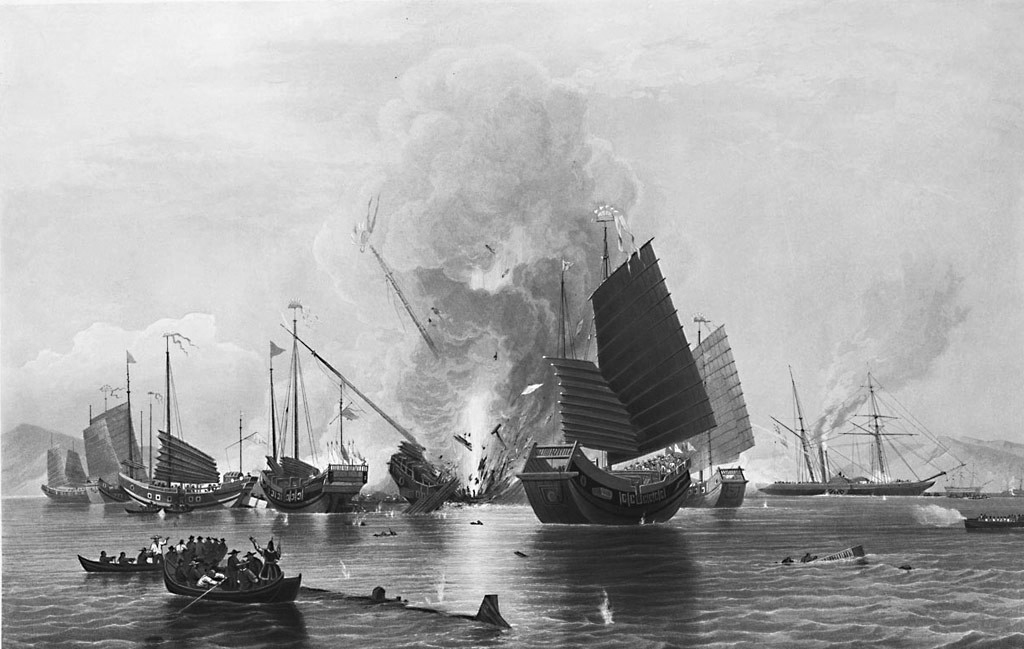
    When the British attempted to convince the Qing Emperor to open trade to the west, he correctly deduced they were swindling devils who could not be trusted and as such refused. But his critical error was in the assumption that the British were unable to impose themselves by force. The Chinese simply couldn’t conceive of a world that didn’t center China, a natural center. The Qing Emperor treated the British as barbarians offering tribute, and gracelessly declined any ‘equal exchange’ with the foreign devils.

    The British, of course, who had proven in India to be rather enterprising indeed, viewed the world as something largely acquired through the supremacy of its gun-toting steamships.

    There was no ‘moral depravity’ to which British capital would not stoop. Honour was a relic of the past, of the Anglo-Saxon impulse, the desire of Alfred the Great to unify a fractured petty kingdom to defend against a horde of foreign invaders. British capital was profoundly Norman in its sensibilities, however; the rule of the deed, of seizing what you want, and in the process laying the foundations for a rootless international hierarchy even beneath the auspices of an ostensible ‘nationalism’, as it arose.

    Honour lay dead, alongside the Cavaliers in St Fagans.

    So the British simply sold Opium to the Chinese. When the Chinese fought back, with their heavenly emperor and his heavenly armies, the British crushed them with the swiftness and brutality they’d been taught in Europe. This ‘genteel’, honourable lot would have sold their own grandmothers into slavery for a quick pound note, and it earned them the world.

    British honour, British brilliance, British ingenuity, were only mere characterisations of flintlock muskets, modern banking, Bessemer steel, and the urgency of an empire that had to be sustained. In every instance in British imperial history we see a delicately positioned house of cards that could collapse over at any moment. What appears as an almost inevitable order of supremacy was in fact something routinely challenged.

    We all know of the necessary depravities of the ancient mediaeval lords. We also know their unnecessary depravities; Henry VIII’s cruelty to his wives, the extravagance of Marie Antoinette, the absent-minded stubbornness of every other Habsburg princeling.

    Under capital, however, every depravity appears necessary. The cruelty of its reign is the constant reaffirmation of the predominant order, the ability to act without mercy, to forget the chivalrous ideals now entertained only by children and reactionaries (though I repeat myself). The British revolution was the revolution of steel over iron, flint over snap and wheel, steam over sail, inaugurating a reign of terror not even Marat would’ve stomached, because it was in service of no enlightened ideal but the truths contained in that steel, flint, and steam: of deeds before words.

    Though the Qing Emperor would’ve had you believe otherwise, the Chinese were not incapable of wielding these truths either. While the bureaucrats and aristocrats certainly couldn’t, the ‘reform’, the opening-up of China’s markets, did in fact lead to dynamism and agency on behalf of hitherto then marginalised classes. Across China, the western powers, in treaty after treaty, concession after concession, established multinational zones in Hong Kong, Shanghai, Qingdao, Harbin, Macau, and so on. The Europeans erected a series of lesions on the empire’s skin, where these rootless cosmopolitans could get down to business, far away from affairs of heaven.

    The Europeans didn’t understand it either, even as the same process was going down in Japan, but they had sowed the seeds of China’s self-realisation, and thus their own defeat. But for capital, it stood on the cusp of its own realisation: of the creation of a manufacturing market encompassing all those souls, liberated from the parochial rule of lords and emperors, sharpened to a point on a spear called labour.

    Enter the great bourgeois revolutionary Dr. Sun Yat-sen, the father of the Republic of China. This man, had the Qing their way, would have remained a dirt-munching peasant like his parents. But the rule of heaven’s son was of no consequence anymore, and he became a free cosmopolitan, with an American education. Filled with the auspice of all those ideals, he possessed like a fire in his heart the germ of China’s self-realisation. He alone would shatter the empires, Chinese and European alike, and bring about an end to the unequal treaties, to the concessions, to the century of humiliation.

    Unfortunately for Dr. Sun, men may make their own history, but they do not make it as they please; he would die, his free and equal republic unrequited, inherited by a lesser man, a coward in strongman’s clothing, manifestly unsuited for the task of republican modernisation. This warlord-in-chief, Chiang Kai-shek, had not identified the real future of China, and was also couched in the sins of his ideological forefather, and the movement behind him, which did not know how to answer the question of China’s new republic, how to renegotiate the treaties, to appeal to the burgeoning universalism of the Christian empire in Europe.

    Thus appears the most splendid revolutionary of his day: Mao Zedong. What Maoists and their critics both forget is that the tenants were mere rural proles in general subservience to a patchwork bourgeoisie. Mao’s “new democracy”, an appeal to air, to mediate a class contradiction that did not in reality exist, obscures this.

    In lieu of an international revolution, Mao inherited a classically bourgeois tradition nevertheless couched in a real momentum of the proletariat. While the Republicans attempted to elevate themselves above their basal instincts, Mao indulged them, and instead inherited the mindset of the British brutes who’d ransacked his home country. When the Japanese marched down, Mao was a dishonourable fiend, an enemy to his country and a friend to its people. He hid in the mountains, the countryside, and let the nationalists absorb losses and the blame for them, building support through widespread land reform and winning the heart of the peasantry.

    We see in Mao’s movement the same house of cards, acting with that same ferocious, amoral brutality, learning at long last to behave as the barbarians. Mao’s revolutionary depravities, of an incalculable quantity, were indeed depravities of necessity, the life of the movement itself contingent on their swift execution. While in ruling over China he reformed the land relations and irreversibly changed the social orders on which the traditional society was built, he lay the ground for the true revisionists, the modernising ‘rightist’ clique, to finally take their place in the sun, cast off all pretensions of higher ideals, and without a second doubt tossing the proles in sweatshops, to be alienated as the rest.

    So emerges the modern empire of China, the supreme exponent of the world-civilisation, the unity of manufacture and finance, the seemingly impenetrable dirigisme now no longer consigned to the mandate of heaven, the narrow-minded peasant superstition of dead emperors that imposed a cyclical history on the masses. But as with all such childish things, modernity too disposed of it, and now, as the Europeans and Americans who once parasitised the east squabble over air and decline, the Chinese stand stalwart, unmoving, the best of capital’s attendants. They learned to build heaven on Earth, and like Laozi’s brutal heaven and Earth alike, which treat the people as straw dogs, it is one of the necessity of brutality, its fierceness, the rule of force.

    Those who say, “nobody wants to die for an international economic zone” do not understand this: entire armies have fought and died for international economic zones. And it is only in these cosmopolitanised, rootless Bastilles, constantly stormed by the exchange of goods and people, that old ways can be changed.

    Here in Britain, we feel alike China’s century of humiliation. But we are not beset by foreign barbarians and their supremacy over us, but rather the arrival of a vast cohort of new and foreign folk, who simply come here because it is where the money is. The international economic zone is no infliction of a conspiracy, but the natural progression of capital. All which stands in its way must be set aside, and this includes the bigotries of the provincials, who want in Britain a quiet nothingness, somewhere where history refuses to happen.

    When history happens regardless, these people, alike the Qing bureaucracy and the dirt-munching peasantry, who held so much in common, will attempt to prevent it, to toss the tsunami off the shore. They look to London, which only cosmopolitanises further, which only sinks lower and lower, creates more and more desperate people, scum of the Earth, with no roots and no loyalty, and where it drives this behaviour in the ‘native’ whites just as much as the immigrants, and they scream: “expel the barbarians!”

    Of course, our slogan will not be “expel the barbarians”, but “down with the twenty-one demands!” For that to happen, we need our own twenty-one demands, and they must come with the iron hand of capital, its momentum indifferent to the screams of the populists.

    For should the reactionaries succeed, elect their chain-smoking alcoholic to the premiership, and should he, against the tsunami, against history, against progress, manage to toss this wave back in the sea, with the might of his army of pensioners, should they turn mundane this burgeoning lesion, the final and complete destruction of the nonsense “British” ideal, and if, forbidding nothing, the hinterlands finally succeed in taming London, the ramifications will be more than humanitarian: it will be a world-historic defeat for communism.

    The ‘old working class’ of Britain must be eradicated wholesale! All common traditions, chain-smoking, pint-chugging, football-punting philistinism, must evaporate! There is only one human heritage in land and power, and we must build the power to seize the land. If the British working class won’t advance communism, we must dissolve this working class and appoint a new one. The revolutionary subject’s historical reconstitution is only one of the many joys of capital’s development, working in spite of itself to conjure up its own destruction.

    We, the progenitors of the new society, must look upon every depravity capital inflicts, take notes, and when the time comes, with the army built for us by its hand, we will mete out the response to each injustice wholesale, extricate all the land and power from the hands of the oppressors, smash their hegemony, and at long last complete our historic task, and revel in the victory of communism.

    Come on, ye restless and weary. Here in Britain, you will find nothing but pain, indignity, and suffering. But you will learn to win the world.

  • The Myth of Consensual Revolutions

    The Myth of Consensual Revolutions

    A Consensual Revolution?

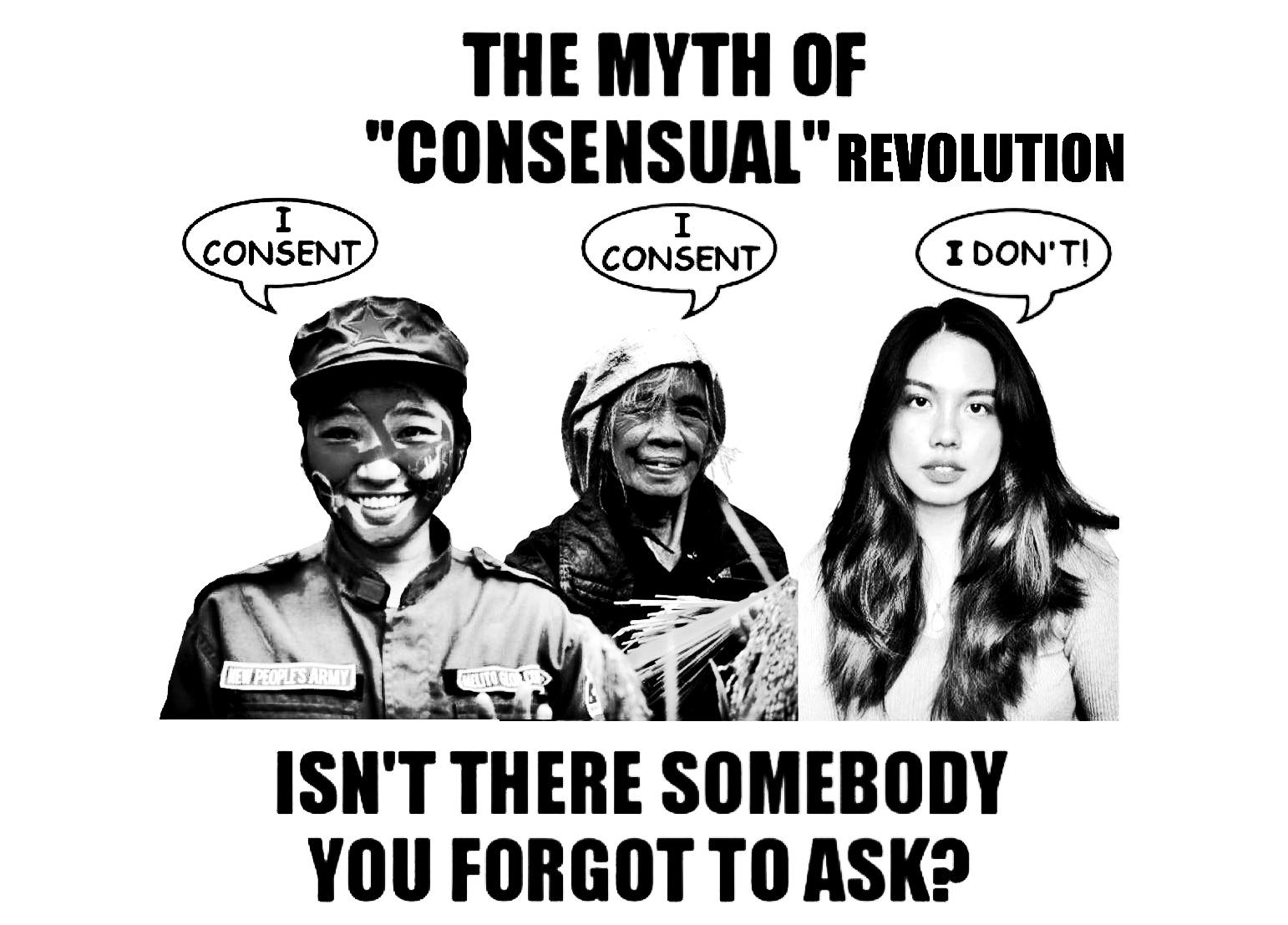
    The self-evident and banal impossibility of such a thing confronts us and laughs, spattering saliva and all, upon our faces. Only the mercenary intelligence of the by-gone Utopian Socialists and today’s decomposing Liberals alike could conjure up such an imaginary. Does the worker consent to the conditions of her life and thus the very same which poses unto her the question of turning over the world in revolution? This is the question Nikka Gaddi poses to her internet e-mass base, and directs to the motley array of revolutionists of our times.

    I. Yesterday

    We find ourselves at the summit of liberal emancipation. The worker is free in two senses: free from the land, and free of property. This freedom, though, has been forced upon her. She has no obligation to the land and to a lord, and she has no property to sell to make a living. What she has is pure, purposive, creative human ability to labor. So when the worker engages in the labor-market, she engages in it as a seller of labor-power. Thus far, none of this has been to her active consent. Torn from the commons by enclosure and statute, her ancestors’ subsistence stripped away so that she might stand “free” before buyers of labor-power, this was the original compulsion that made her a worker in the first place. Then we have a freedom of the herring to be salted.

    Proletarianization is precisely the process of de-subject-ification—i.e., of dehumanization. Where liberal bourgeois society relativizes the ability to consent to the sovereign individual, the human subject as such, the proletarian is definitionally not “human”. For the immutable tablets of Universal Human Rights declare unto bourgeois civilization the ‘right to property’, and whom among us has none? And whom among us counts as Human?

    II. Who counts as Human?

    She finds the Eden of the rights of man, where alone rule Freedom, Equality, Property, Bentham, and enters the marketplace as a legal equal. Having offered up a contract, which she herself cannot pass up else she dies of starvation and cold, trampled by the bustling cities of apathetic urban civilization as a homeless, lifeless body upon the asphalt, she sells her capacity to labor for a day, for a wage.

    So the job offer is sealed and thus her labor-power belongs to another. Inside the factory gates her purposive activity is no longer her own, set to work under rhythms dictated by machinery (her ilk had made to the profitable benefit of her employer) and the ticking clock. Every gesture of the arm, every twitch of the eyebrow is prescribed, fragmented, subordinated to a process she does not control. The products of her hands flow away from her into the warehouse and up into the market. She cannot take part of this of course–she gets paid in cash. So to access the fruits of her labor, the worker clocks out of the factory and dons the social role of the consumer. What the worker’s own hands created confronts her as a thing with its own life, a commodity owned by such a thing as “capital”, having grown from her living labor yet utterly alien to her. “Capital” dictates the rhythm, intensity, and organization of work, and, now as is made self-evident, even of consumption and the conditions of life itself. Wouldn’t you know it, she can’t afford the damn thing! Her own objectified life returns as a power that dominates her very being. The product of her labor acquires a life of its own, and in doing so strips her of authorship over the world.

    So her labor dies. It’s dead. And corpses, not content with “weighing like nightmare” on our brains, do nothing but accumulate, so the products of yesteryear, congealed into machines and money, rise up as “capital”—a self-valorizing process that seems to move by its own volition. Capital purchases raw materials, machinery, and her labor-power (by now no longer purposive human activity as such but “capital” in and of itself), combines them, and conjures forth more value. Now the worker is a living appendage of this dead machinery. Capital’s command—accumulate, accumulate!—dictates the length of her day and the intensity of her toil. She is but a personification of wage-labor—and as far as the employer is concerned, a perfectly interchangeable [disposable] pair of hands. Her desires, her pains, her creative impulses matter only insofar as they can be disciplined into profitability.

    In the completion of dehumanization, the proletarian becomes a living nerve grafted onto a dead body that, vampire-like, drains her life-force of every single drop.

    Driven by the blind compulsion of self-expansion, this system periodically convulses into crises. It produces too much. Actually, she produces too much. The machines stutter and stop. She, having been too productive, is expelled onto the street, joining the “reserve army of labor”. Effectively she is pronounced dead, and the market periodically performs necromancy on that great mass to raise them to the status of undead, zombies haunting the living, threatening other workers by pushing the pressure of wages downward in competition with each other.

    The myth of free contract shatters against the irrationality of a crisis she had no hand in creating. She starves because there is too much food! But “too much” is a relative thing, too, its meaning acquired according to the imperatives of profiteering. So she goes homeless because there are too many homes, becomes a thief because there is too much money, dies because there is too much medicine.

    III. So the dead rise

    Thus far, none of this has been to her active consent.

    Out of this repeated whipping of booms and busts upon her flesh, repeated across millions of lives, whether by the blue moon’s chance or a never-again realignment of the stars, a “necessity” roots into the earth’s crust and forces a crack upon it to bloom in open air. The impossibility of living under these conditions ceases to be a private misfortune and becomes a collective condition. The worker, atomized by competition, is welded together with other workers by this immense suffering and impotence they all share. Even then, this is not to her active consent, but forced upon her by the excruciating pain of the empty stomach boiling in acid, the splitting pain of cracking bones. So the dead rise up, revolting against death. They take up the labor of grave-digging.

    Observing the irreducible suffering of the working people in his time, and the advances in class struggle achieved thus far by history, Marx notes with exceptional clarity: “What the bourgeoisie therefore produces, above all, are its own grave-diggers.”

    Even revolution then is not to her active consent. To escape this world, and in fact to destroy it, to smash it to pieces and burn it to ashes, to leave nothing standing in front of her—this is a most profound need, a world-historic necessity, forced upon her by the radical unfreedom, precisely in bourgeois freedom, that has defined her entire non-existence. The expropriators are expropriated—they must be expropriated. The fetters must be burst asunder. She is delivered into revolution by the full force of her dehumanization.

    Only on the far side of that rupture does the possibility of freedom flicker into being. The working people are forced to make the leap to the ravine, in the rift of the realm of necessity and the realm of freedom.

    IV. Guilty on three counts

    So the liberal pieties about “consent” have been exposed. The solemn ritual of free will hollowed by the dull compulsion of the empty belly. Revolution by a majority vote in the parliament of the champagne-quaffing Socialist Petty-Politicians, the whole sorry carnival, with the interminable functionaries who have never felt the lash of real hunger—notwithstanding the traitorous salt-of-the-earth Labor cretins learned in the ways of machofeudal populism—is the wet dream of a stratum too impotent to imagine its own end except as an extension of its own procedures. Put simply: the working people cannot consent to revolution because they cannot consent to anything at all, insofar as they are, for the foreseeable future, to remain as workers. Proletarians are cattle, definitionally speaking. The root Latin of the word quite literally means ‘offspring’ (or the producer thereof being the sole source of one’s value to society). Consent itself is a category of bourgeois right, the legal form of the isolated monad, and it evaporates at once should we grasp that the subject who would consent is already the product of the very relations she is supposed to overthrow. So far, so good.

    But what of those who, scorning this liberal wet dream, propose instead to make the revolution—to seize history by the throat with the iron will of the Party and the barrel of the gun? Here we encounter the second face of voluntarism, no less idealist for its martial postures, no less trapped in the inversion of materialist understanding for its pretensions to scientific strategy. The consent of the few makes no revolution but a hiking trip toward ranges infested by gun-touting State dogs, foaming with rabies at the mouth at the sight of dead students and journalists and scientists and farmers—leaving nothing behind but corpses martyrized in the pages of Ang Bayan and the smoking ruins of displaced communities. If the liberal imagines revolution as a sign-up form penned by willing individuals, the voluntarist imagines it not really that much differently, as a project executed by The Willing Few—the Party-army and the guerrilla column that replaces the absent class with its own motion and blood. If Nikka sees history as a negotiation among competing blocs of influence, National Democrats see it as raw material to be sculpted by sheer partisan audacity. Despite appearances, both fundamentally agree on the decisive point, which is that revolution is a product of the will. They merely disagree on whose will counts.

    This shared ground is the very foundation of what has been known to the Left as the pathology of activism—the privileging of the motion of struggle itself as the index of revolutionary politics, the frantic assumption that, with enough Action thrown at one’s object, which could be anything, all shall be well, and will transmogrify into qualitative political development regardless of what the objective balance of class forces permits. Activism is the nervous tic of a politics that cannot wait, that cannot bear the immobility imposed by an unfavorable conjuncture, and so fills the void with ceaseless Doing. Its theoretical grounding, voluntarism, is the inversion of the materialist axiom that social being determines consciousness, substituting the overdetermining will of the organized, willing, Consenting minority for the actual development of the capital-labor contradiction as the motor of historical change. And its practical, tactical expression is invariably the adventurist attempt to force revolutionary outcomes through audacious blows when objective conditions do not support them, generating not the awakening of the masses, who remain in their day-jobs and villages watching, often with scorn, yet another self-immolation at the altar of “terrorism” and its impatience, but the exposure of the Consenting to repression and the destruction of organizational capacity that took years to build.

    These three counts are the symptoms of an inability to grasp capitalism as a totality whose contradictions evolve according to determinate laws that constrain what is politically possible at any given moment, and the symptoms make the rot worse. They are the rage of the impotent will.

    The People’s War, we are told, very much unlike the urban adventurists of Manila–Rizal just some decades ago, is a scientifically calibrated strategy, a long march through stages, a patient accumulation of forces that awaits the ripe moment. The guerrilla-liberated zone is the embryo of a new state; the Party-army is the formal expression of political power from the gun. This is voluntarism in its fullest institutional elaboration, and its apparent opposition to adventurism is precisely what makes it lethal as an opportunist rot. For the voluntarist logic is not an accidental excrescence on the PPW; it is demanded by its premises, by the very analysis that claims to ground it.

    What is that analysis? The bankrupt semi-feudal and semi-colonial thesis, by mistaking the specific form of capitalist subsumption in the periphery for a hybrid of modes, writes the proletariat out of the script. The worker is no longer the subject whose very existence as variable-capital, as the living negation of the capital relation, necessitates it to be the grave-digger of the capitalist mode of life, but becomes merely one ragbag of The People to be mobilized, organized, and led under the capacious tent of the Party, who, having formalized the path forward, provides the “socialist perspective” of the petty-bourgeois revolution. But if the Party is not the concentrated expression of a class that is already, in its being, the antithesis of capital, then what is it? It is but a substitute, the few that must make the revolution because the actual movement of the class cannot be trusted to produce it. The Party-army is the world-historical subject, divinely annointed by itself, and Protracted War is simply the form through which the Consenting labors to bring forth a new society from the womb of the old, stillborn and blue as the baby always comes.

    But the gun is not the servant of class power but its surrogate metallic fetish. The “new democracy” that PPW aims to build is a capitalism without compradors, a national capitalism with a red flag, and its historical role is not the abolition of wage-labor but its generalization under a different (crucial: Patriotic!) administrative configuration, and thus a voluntarism swollen into a state developmentalist project, and it is a bureaucracy no less anti-communist for the blood it spills.

    Now comes the objection, half-sob, half-accusation: “But what should we do, then? Just wait? Sit on our hands and let capital grind on while we polish our theoretically pure knobs?”

    This objection only appears compelling, of course, if one has already accepted the voluntarist premise that the only alternative to the National Democratic struggle is the inertia of the impotent sect. But this is precisely what is being contested. The communist response to a society mired in counterrevolution is not to pretend the conjuncture is something else by substituting the Will of the Few for the movement of the class. Nor is it to dissolve the program into opportunism by chasing the majority in conditions where the majority is atomized, passive, and saturated with bourgeois ideology from scalp to sole.

    What militants embedded in the orbit of the CPP-NPA can concretely do is not nothing. It is the same thing communists have always done in conditions that do not permit the direct revolutionary assault: preserve theoretical clarity, refuse to subordinate class politics to interclassist alliance frameworks, work toward organizational forms that correspond to the general interests of the Filipino working class as a global class rather than as a national-popular subject, and above all, resist the catastrophic temptation to treat the party as the class. Keep the knife sharp. But the harder answer, the one that cuts to the bone, is that the CPP-NPA’s theoretical foundations are not errors attached to an otherwise sound communist core. The semi-feudal thesis, the substitutionist logic, the national-democratic horizon are not just tactical mistakes but precisely the direct expression of a voluntarism that can never, by any number and intensity of rectification movements, become the real movement that abolishes the present state of things. The rot of a few apples rots the entire barrel.

    Ultimately both the cretinous Liberal and the gunpowder-headed Maoist are trapped in the same pathetically bourgeois subject-centered metaphysics that cannot grasp the dead-weight of prehistory, the blind autonomized movement of capital that drives toward its own negation without asking anyone’s permission. The working people do not consent to revolution and neither do they manufacture it in the guerrilla base area or the party headquarters. The revolution is forced upon them by the intolerable totality of their own dehumanization, and it is forced upon them with all the violence of a history that has never once consulted them. Only when the realm of necessity is brought under the conscious collective control of the associated producers and the working day is shortened to open the space of free human development—only there can the question of revolutionary “consent” even arise.

    The People’s War is deemed guilty on three counts of Voluntarism, Activism, and Adventurism, and it must be forced to realize this guilt through the baptism of fire. History necessitates it.

    V. The realm of freedom

    We shall not “intend to save” anyone.

    To consent to this life in any full sense is impossible. The conditions of existence are not available as conditions to be accepted or refused; they simply are, the way gravity simply is, and what passes for consent is only the daily reproduction of what has been given.

    Consenting to life is possible only to new people. What propels us is the dead-weight of the human prehistory that is class society unto its end, and we are thus driven to leap by the impossibility of continuing as we are. Communism, the real movement, is “the riddle of history solved”, the leap from the realm of necessity to the realm of freedom.

    Just as against Rome the wild hordes were needed – so that so many and great useful contributions to the organisation of people and things would not be lost – which were unconscious contributors to a much bigger revolution still far away in time, we want the gates of this bourgeois world of profiteers, oppressors and butchers to be struck by a powerful barbaric wave capable of burying this world among itself.

    Amadeo Bordiga. “Forward, Barbarians!” (1951)
  • All Support To Starmer!

    All Support To Starmer!

    For a long time, we, the Party of the Communists, have been in resolute opposition to “Herr Keir Stürmer”, the bureaucratic dredge of neo-Blairite rot that presides over (what is left of) the British state machinery.

    This position must change, as reality has changed. “Herr Keir Stürmer” has, for the first time, become a champion of the proletariat. His continued leadership over the Labour Party, and the United Kingdom, is now contradistinct to the interests of the British bourgeoisie.

    Britain is a patchwork state, all common ‘identity’ thrown to the sectarian wind, where nobody knows what Britain is, or how to speak to it. We, who have not once attempted to speak to Britain in the first place, who see no abstract personage behind the ruling idea, raptly support this. The common national community is another abuse which the bourgeois civilisation demands the perpetuation of. We support all forces which make concrete its demolition.

    Keir Starmer, long toying with the prospect, has finally become one of these forces. He has, in defiance of all ‘political sense’, thrust his ego over the continuation of the country, of his party, of his government. It is becoming readily apparent that there is no length Starmer won’t go to to keep his grip on a ‘power’ so hazy it may well be air.

    Those of us who abstain from electoral politics now find ourselves tasked with an election that is not about legislative strength, but the undemocratic mediation of the executive. The bourgeoisie demand, through Makerfield, that the class-traitor Andy Burnham seize executive power, to save Britain from a reckless and self-destructive Starmerism.

    But Starmerism isn’t about anything at all but Keir Starmer. Where the infantile, sniveling wretches of capital’s left flank demand they try and corral civil society into a state of anything but social oppression, and in doing so become its staunchest allies, Keir Starmer stands their fiercest opponent. Thus, our staunchest advocate. If this would-be Mussolini has his way, the civil strata will have no chance to prove themselves, the British political project will continue to collapse into yet more nothing.

    We must, at this critical juncture, have the bravery to say: long live this butcher, now in rebellion against his judicial socialisation, who has run out of boxes to check and now lives in defiance of all sense, all order, all ‘civilisation’, whose aspiration as survival is rule by no authority but his own. Were this despotism made true, he would continue to ruin this country, and as opponents of this country, we stand in full support!

    As for Burnham and the two-timing Streeting, they are clearly trying to fix things, alike Polanski, whose coalition threatens to tie a new ‘Britain’ into being. Should they rescue the ‘Labour’ Party from our wrecker on the inside, they may prove its utility to capital yet. Should this happen, should the festering boil be soothed, the revolutionary subject may yet again postpone its conclusion that the capitalist limb must be amputated wholesale from the human species.

    The Makerfield by-election now becomes a junction for Burnham’s entry to the Party of Order, and it is a junction that must be closed. We call on all of Makerfield’s progressive elements to work, at any level, for his defeat, in service of any other conclusion but his victory. There are those who are troubled by the prospect of a Reform victory, and we admit this would be displeasing to us. But all that matters now is the British state; something the Fagash Führer could well resist through wrecking.

    If Starmer has his way, we do not think Parliament will be powerful enough to execute the manifest harm Reform UK intends to bring. Then, the only avenue left is class power. We will remain in rapt support of the “sensible” centre-left, who prove time and time again, in every instance of history, the supreme proletarian principle: Communism is the only frontier worth advancing.

    May Blair’s shadow cast its own shade, and in its cynicism alone prove the worthlessness of the British state. We stand to gain immensely from the victory of the son of the Toolmaker, and we encourage him to hold firm, steadfast, against the historic storm of his bourgeois opponents.

  • A Sermon From Father Arnold

    A Sermon From Father Arnold

    Introduction

    We here at Negate! are, in a word or two, supremely iconoclastic. That is to say, we have no gods, saints, preachers, mystics, holy texts, et cetera, and we are very invested in seeing the demolition and deposition of all such childish things. We do not believe in ghosts, banshees, spectres, the ontological will–or, inasmuch as any of this ought relate to politics. I cannot truthfully speak for my colleagues’ personal interiorities; being oppressed creatures, they may sigh in some certain fashion or another, and in some cases that sigh may take the form of God.

    Alas, cruel reality sheds light through the window, and one day we must take up the working assumption that the saints we hang up there are simply icons, and there is nothing holy in the depictions strung above.

    This is because our materialism is negative. We do not take capital for its poltergeists, but for its working mechanism; we do not create a teleology of the present from a future position, but develop our understandings with the living doctrine of our time. We are abolitionists.

    Positive materialism, however, is presented with a problem here: for any abstraction they deem worthy of use, ‘reification’ and ‘fetishism’ is essentially the same thing.

    ‘Reification’ being the process by which a real thing is articulated as an abstract concept; ‘fetishism’ being the process by which the thing is treated as that concept. Please defer to our good friend Plato about how this essentially means all instances of that thing descend from the One True Thing (to rule them all, and in the Textwall bind them).

    When a positive materialist concocts an abstraction, the materialist must then have it all make sense in an academic stratum; to codify it, in the Glorious History of Ideas. This, in turn, is then strung, through precedent, peer review, into a ‘scientific socialism’ that, over time, comes to address only the reified abstractions.

    Once this grotesque sophistry has been finalised and put to paper, we may now instantly regard the form itself, and have a bunch of dead academics do all the heavy-lifting of fetishism for us.

    This Deviance is presented to the Sensitive Communist Youth as real thinking, real science; that the perverted mystic, in the guise of intelligentsia, actually understands the fetish object better than the philistines.

    No more does this confound the positive materialist than the state. These people profess to have read Marx (who readily and bluntly addresses the state as a mere idea), and then play with the idea itself in lieu of the other ideas behind it; addressing the other ideas, as Lenin did, makes a precarious approach toward the real world.

    One might possess a working state theory, hidden in the background, communicating through the Ley Line of History, but at some point the abstraction turns to air when discussing it. In any case, because the liberal ontology presents its state as something equivalent to God, and yet we are told Communism is stateless, so the defeat of God becomes a battle, not his passive dismissal by modernity; we may find workarounds to the ‘state’ monad, and its attendant noumena, but we tie ourselves into knots when we come back to Karl Marx, that hideous Prussian oaf, who defeated both.

    We here at Negate! do not consider the state-category useless for analyses. But we refuse to treat it as anything but its appearance.

    This is not so for some people!

    Enter the lauded Cosmonaut Magazine. I have long been infatuated with this particular Church, but their sermon drones on to the point of boredom, no matter how much money they put on offer. I will tell you how I have quite literally prostituted myself in dire financial straits; but I have never, as of yet, debased myself so far as to submit an article to Cosmonaut in pursuit of money.

    Beneath the ‘Neo-Kautskyist’ auspices of the Notorious Donny P (the American Left’s very own pícaro), this magazine has yet again assailed our senses with a new article: Toward a Marxist State Theory of the Socialist Market Economy, by Theryn D. Arnold (a candidate PhD in Geography; we wish our mystic well in this regard). You can read it on Cosmonaut here.

    Father Arnold seems an affable enough chap. But make no mistake, he is a priest, a mystic! This particular Smart Cookie, successfully gaslit into the Church of the Position by the self-selecting myopia of the Sensitive Communist Youth, now provides his analysis of China’s ‘socialist market economy’; and alike the enlightened centrist, he implores that we move beyond our present, banal understandings of China as ‘capitalist’ or ‘AES’, and move forward, into his own blinding light! His critique of the theory involved is necessarily idealist, and is based on dialogue surrounding the left, and the correction of some of China’s ‘critics’ and ‘supporters’.

    Now it is apparent that China’s ostensible ‘socialism’ is in fact not a mystical property passed down through the Tao Te Ching and Confucius, nor some tautological claim about the collectivism of rice farming, we attempt to understand it again. This lies, however, in the ideas, states, princes; never the social relations!

    To our shock and horror, the priests, their churches demolished by Xi Jinping’s gelatinous fist, now turn, in trembling awe, to lay the founding stones of another.

    We must not let up! We must not hesitate! Peoples across the world have, in that noble Jacobin tradition, littered history with the corpses of priests and preachers. So let us continue, rifles held forward, in the spirit of the Bolsheviks, Catalans, Red Guards, and all the rest of those who, with a noble and terrible sense of duty, took it in their hands to smash every church and temple they could find.

    I

    The Idealist Conceit

    This response will be cut into three parts: critique of Father Arnold’s idealist dialectical framing, addressing the vagaries of his criteria, and the inadequacy of his resolution.

    I would wager any one of these is enough to reject the premises of his gospel outright.

    Let’s start with the first.

    Father Arnold, as an academic, is prolific in the merchandise of ideas. The entire premise of Cosmonaut is the development of a scientific socialist space; one that is intelligent, academic in tone, with citations, reasoned critique, et cetera.

    The article in question is a ‘critique’ of the discourse surrounding Chinese political economy. It is (allegedly) scientific, intelligent, academic indeed. Father Arnold, furthermore, suggests his state theory on China is a Marxist one. This is a bold assertion! If this is the case, then he will have provided a materialist critique.

    Let us review his case then.

    Father Arnold tells us that there are two dominant Marxist stances on China’s political economy: the ‘campists’ (who uphold China as socialist) and the ‘state-capitalist critics’ (who do not). He sees both as substantial positions in this day and age, but they are products of the same error; ‘mirror images’, so he claims. Both get something right, but it is this error, this single error of thought, makes both distinct from the real truth. If this is rectified, the two outlooks can be synthesised into a truly Marxist state theory.

    We must assume that Fichte is the principal saint of Father Arnold’s parish.

    Father Arnold first paints us a picture of the ‘socialist market economy’ as it emerged in the eighties. This, which Father Arnold assures us did not emerge from a theoretical blueprint (as opposed, presumably, to those famed economies which were simply wished into existence by a theoretical blueprint), is distinct from ‘market socialism’:

    It is worth pausing here to distinguish the SME from the market socialist tradition with which it is sometimes confused. Market socialism – in the versions associated with Bardhan and Roemer, or with Schweickart’s Economic Democracy – is fundamentally a normative-institutional project. This means these scholars try to figure out how to design a socialist economy that retains market mechanisms for efficiency while subordinating them to socialist property relations. The market is an instrument to be engineered within a socialist framework. The SME inverts this relationship. It does not propose to subordinate a market to a socialist design; it proposes to derive the socialist character of a market economy already in operation through public ownership dominance and party direction.

    What Father Arnold is saying here is effectively that the egg comes before the chicken; that the SME is distinct from the market socialism we know, because it is about a market deriving its Socialism Particles from existing state and party control, as opposed to the persistence of market mechanisms under socialist property relations. Here, socialist property relations refers to ‘worker ownership of the means of production’; co-ops, people owning their otherwise marketised workplaces.

    What’s interesting is the cases invoked for ‘market socialism’; in lieu of existing examples of market socialism in practice, Father Arnold angles for the theories of Pranab Bardhan and John E. Romer, or those of David Schweickart.

    All of the models proposed by these people do invoke the traditions of past market socialist experiments; Schweickart proposes a model in common “with Yugoslav socialism, with Japanese capitalism and with Mondragon [a collective in the Basque region of Spain that began under Franco’s regime] cooperativism” (Schweickart 1992, p. 18). The resulting proposal, as the Sensitive Communist Youth will probably intuit, resembles something rather fascist.

    A problem with all proposals cited is that none of them have ever existed in fully-fledged practice, as China’s ‘SME’ has, and yet Father Arnold uses them as his comparison here; certainly, one could take the case of Yugoslavia’s ‘socialist self-management’, a system that actually existed (with similarities and differences to China’s own situation, albeit warped by scale), that can be measured via its outcomes, but Father Arnold at present seems deliberately unconcerned with the real world. He does sort of mention Yugoslavia, and other market socialist experiments, but as scarcely more than a footnote, much later in the article; as with all priests, heaven remains more important than Earth.

    In any case, to take his claim seriously, Father Arnold’s statement here is that the ‘socialist market economy’ is not a normative-institutional project at its foundations. But China’s political economy, he wagers, requires a structural framing, not a normative one; i.e., one that does not simply address the premises of Chinese party ownership as articulated, but its existence as contextualised by the way all the systems link together.

    In effect, what Father Arnold is telling us is: you cannot understand China simply as a party-state, but as a party-state with a state-directed market economy.

    Fucking groundbreaking. Take the salt from your tears of joy, and shape it to a medal for Father Arnold.

    The ‘campist’ position, Father Arnold astutely observes, is largely contextualised by understanding China on its normative claims: that because “the party-state owns strategic sectors, directs industrial policy, and declares socialist goals”, it is, in fact, socialist. This, says Father Arnold, cannot possibly be a full analysis. Praising the position for its ‘virtue’ in ‘taking the socialist question seriously’, he still nevertheless says it fails to take account for how the Chinese state could possess an operation independent of Party intent.

    Of course, the ‘state-capitalist’ position must invert this error, so says Father Arnold:

    The state-capitalist position makes the opposite error. By identifying capitalism with the presence of wage labour, market competition, and surplus extraction – all of which are present in China – it dissolves the socialist question entirely.

    You read that correctly, friends. This ‘state-capitalist’ position permits the profanity of identifying capitalism with the presence of capitalism, and thus concluding socialism cannot be in evidence. As good Hegelians, we could never accept this.

    Now, let’s give Father Arnold a chance to explain himself. According to him, this position adopts the following stance:

    China is simply capitalist, the CPC is a ruling class faction, and the SME is an ideological fig leaf.

    To start with, the argument attacked here is one that proposes China as simply capitalist, with the CPC as a ruling class faction that seems to deliberately offer the SME as an ‘ideological fig leaf’ and no more.

    One of the sources provided for this understanding–David Camfield’s Red Flags: A Reckoning with Communism for the Future of the Left–curiously resists this sort of scrutiny, because it doesn’t actually propose the SME as the initial exponent of Chinese capitalism. Rather, it claims China has never been transitioning to communism at all:

    Without question, though, in spite of what CCP leaders have maintained, China has never been in transition to communism. The Chinese Revolution ended semi-colonial domination and unified almost all of the territory of the former Qing Empire under CCP rule. It established a one-party state that implemented social reforms and industrialized and modernized the country. This laid the basis for the extraordinary development of productive forces that has happened since the late 1970s, which has given China’s rulers great global influence. These are major changes in social arrangements. However, none of them have involved direct producers themselves taking charge of society and beginning to democratically plan production to meet their needs. None have eroded class exploitation and state power.

    This is important, because it shows that Camfield’s analysis begins not at the SME, but at the social relations upon which the development of productive forces occurred. His criteria for ‘socialism’ and ‘communism’ is lacking (the book itself is kind of dogshit all the way through), but contra Father Arnold, he does in fact have a criteria for socialism.

    Such digs at the heart of the question; one that Father Arnold expertly dodges at every opportunity. At the end of the day, a lot of ‘state-capitalist’ critiques of China’s SME are not about the SME at all. Rather, they are about the conditions laid before the SME; they address in real terms the procedures behind its emergence, and use those to diagnose a socialist character or lack thereof.

    This does not necessarily lead to an analysis of Chinese political economy that is necessarily over-fixated on the past and not the present; nor does it preclude the notion that some people in the CPC may well have been working toward something they deemed socialist. It simply suggests that any ‘socialism’ in evidence cannot be seen as a quantity of economic phenomena, but an outcome of base-level social relations around which the state must necessarily take form.

    Or, in other words, it simply means we do not need to belabour ourselves with justifications as to why China isn’t socialist to any extent we may justify any other state; its politics may be unique, its economic policy may be unique, its state structure may be unique, but yes, the CPC is a boutgeois, ruling class faction, and the ‘SME’ does not need to exist principally as ‘an ideological fig leaf’ but simply as the means of its own perpetuation.

    We do not need to argue on any basis here other than the CPC’s own words and deeds, where Jiang Zemin’s Three Represents have already rationalised the bourgeoisie’s presence in the party as an integral part of the party-state.

    This will not do for Father Arnold! When China tells us: “we would like the bourgeoisie to help us manage our market society”, and then indeed, has the bourgeoisie manage its market society, this cannot be simply capitalist! There must be something else, something hidden, something within which we can discern a truer character, beyond the work of any prior theorist.

    And if we go further beyond; to say, as many have said, that China did not in fact build a socialist economy at all to begin with, as Father Arnold’s own sources for the critiqued position explicitly comment, then we are in fact left with this critique of air, this shadow-boxing of people who do not entertain the very premises upon which Father Arnold argues.

    Here, we have an issue far beyond the notion of the present-day market economy, which is simply that any justification of a modern-day Chinese socialism must emerge from the premises of a previous Chinese socialism. For a working ‘state theory’, this would require a fundamental addressing of what came before, of the function of the Chinese revolution. It would require a comprehensive addressing of several priors.

    Father Arnold does not make clear his position on previous ‘Chinese socialism’, and as such he cannot actually address the critiques he himself claims to be in the process of surpassing. He would do much better if he addressed a Maoist critique–one that takes Mao’s China as authentically building socialism, and later developments as rightist deviations toward a capitalist road–but this is a framing he never addresses. Instead, he takes two irreconcilable positions, and attempts to find a common ground for them, to synthesise them into something workable.

    This, for what it’s worth, is entirely possible in the world of pure thought. It is not really possible in the programme of workable socialist politics, which demands a coherent position. In this department, Father Arnold’s recommended liturgy is particularly unsatisfactory (something to be elaborated on in Part III).

    Father Arnold critiques the ‘state-capitalist position’ as it relates to an understanding the SME as a perversion of socialist character, but does not address the state capitalist position that understands the SME as an elaboration of an already capitalist character. This is ultimately the framing used by the ‘state-capitalist critic’ Camfield, who does not use ‘socialism’ as a category in and of itself, but instead attempts to frame social developments as occurring on top of prior social developments; who dismisses the ‘SME’ not out of incuriosity for its ‘socialist’ character, but on an assumption that the prior social relations are more important for the historical development toward communism, which, assuming communism remains the goal, socialism itself must find its evidence within.

    And I do not agree with the specifics of Camfield’s framing; but this is because I have read and internalised the thesis proposed on its own terms, as relates to a programmatic communist advocacy of praxis. I disagree with his praxis, I disagree with his understanding of communism as a politics to be adopted and not a real force to be harnessed, but I can address these on their own terms, because they are about practice.

    By divorcing himself from this historical paradigm, ostensibly to provide lucidity toward the SME as it exists, Father Arnold instead is incapable of addressing the SME on anything other than its intellectual priors; on predicating his understanding on bourgeois economics to elaborate a socialist character.

    For this, he invokes the theology of a particular Bishophric: Copenhagen Business School. His Excellency Kjeld Erik Brødsgaard, alongside Koen Rutten (scraped out of a Dutch phalanstery), delivers a critical assessment of China’s economic development, in a chapter largely about the earlier history of China’s economic ‘modernisation’.

    But if we are to be building a ‘Marxist’ state theory (a task Cosmonaut might deem Promethean, but is in fact Sisyphean), we cannot simply adopt bourgeois priors with regards to the history and hope we still arrive at an approximation of the Truth, as far as it may exist for our purposes. That’s not science! That’s religion! Introducing more sources might address this prima facie, but all you’re really doing is belabouring the theology.

    At the end of the day, ideas are merely ideas; analyses, merely analyses. For Father Arnold, the work of ‘campist’ proponents, and their ‘state-capitalist’ critics, must be reconciled on the terms they provide as relate to the subject alone, and as such strips both down to principles divorced from what is actually being argued. This must necessarily emerge from a byzantine web spun by the positive bourgeois intelligentsia, not a continuation of a Marxist doctrine. Even in his attempts to provide nuance with a tertiary ‘developmentalist’ analysis, he only belabours the process more, makes its ridicule clear.

    Father Arnold has addressed nothing, proposed nothing, critiqued nothing, and provided nothing in the way of solutions. What he has done is produced a Textwall; a manifestly useless Textwall, which reads with nuance, but delivers us absolutely nothing of substance as relates to the pure ideas reduced out of practical programmes: the ‘campists’ for their support of China, the ‘state-capitalist critics’ for their opposition, and for Father Arnold a mere essay with nothing to offer.

    Let Father Arnold speak as he may. We, personally, prefer Marx:

    All mysteries which lead theory to mysticism find their rational solution in human practice and in the comprehension of this practice.

    Theses on Feuerbach, VIII

    II

    In Search of Socialism

    When addressing a ‘socialist’ form of production (or perhaps, productive character), as positive Marxists are wont to do, we are left with the necessary task of suggesting criteria under which a society can be deemed socialist in character.

    For ‘socialist’ criteria, the distinction at first appears:

    1. ‘Socialism’ as a degree of government intervention in the economy, through welfare spending, state regulation of business, and taxation policy.
    2. ‘Socialism’ as a measurable relation within society.

    The former is a purely quantitative assessment that treats socialism as an essence gradually fulfilled; such vulgarity is thankfully absent from even Father Arnold’s sermon.

    The latter itself must, however, qualify for socialism; at its most basic, the “worker ownership of the means of production”, or through the control of the economy by something ultimately beheld to the workers; a party, a state machinery, et cetera.

    Of course, as taught, positive Marxists are well aware that dialectical contradictions may produce certain oddities within society; that there may be a big old conflict happening between parts of the state with socialist character and parts of the state without socialist character. This sort of nonsense is a stone’s throw from Bernsteinism, but it’s frustratingly common!

    Nevertheless, Father Arnold, here, is somewhat confused, because he does not actually explain what socialism is, to him. Faced with the need to, at some level, defend some socialist element or another within China, he does not actually define what socialism is to him. Instead, he critiques given analyses on their ability to comprehend socialist character in China; completely refusing to elaborate on how socialist character in China ought be comprehended.

    Take how he addresses the ‘campist’ argument:

    But this framework cannot ask whether the Chinese state’s own reproduction has become structurally dependent on capital accumulation through market relations, or whether those market relations introduce pressures that operate regardless of CPC intent.

    Interestingly, the fact that the CPC’s own commitment to ‘socialism’ might be in jeopardy is never even brought up. This framing is important, because Father Arnold invites us to regard the CPC as a centripetal force posed to work against the centrifugal force of the state’s capital accumulation; that the CPC itself, with its almost metaphysical intent, is a force poised to work toward ‘socialism’. As such, the question becomes the CPC’s agency over the state structure, and the bubbling contradiction therein.

    This is the fetishism to which positive Marxism must necessarily take itself; if nature is built on dialectical contradiction, there must be a contradictory element between competing forms. Such, we abstract our analysis to heaven, where we simply have ‘the Party’ (God), and ‘the State’ (the Demiurge), and treat the party and the state as contradictory to each other, unbothered by the affairs of Earth.

    As I’ve already discussed, we do not need to ask on our own terms whether the CPC itself is a bourgeois class organ; they have told us this themselves, and now pursue a path in beautiful, class-collaborationist lockstep with classical fascism–‘harmonious’ development.

    Of course, addressing the stated intent of the CPC is not, in and of itself, part of Father Arnold’s sermon here. His job is to simply assume the existence of a ‘socialism’ manifest in the CPC, and its intent, and work from there.

    He gives us a very elementary dressing-down of why market relations are contrary to ‘socialist development’:

    The most important mystification the market produces is the occlusion of production. In other words, the mechanisms of the production process are obscured – the market presents exchange as a self-contained world; products appear already on the shelves, their origins in the labour process invisible, the class relations of production hidden behind the apparent equality of buyer and seller. […]

    […] This means that, for Ollman, the capitalist class rules not primarily through lies or distortions deliberately propagated by ruling class ideologists, but through the unremarkable daily experience of buying and selling that anyone living in a market society undergoes.

    […] What [the Campists] do not address is the ideological effects of market participation on Chinese workers and citizens. If Ollman is right – and there is no reason to think market mystification operates differently in China than elsewhere – then the daily reproduction of market exchange in the SME generates structural pressures on the consciousness of people regardless of the intent of the CPC or its official ideology. […]

    Here, is perhaps the sharper point of Father Arnold’s sermon; his stance here is from an essay by Bertell Ollman, titled Market Mystification in Capitalist and Market Socialist Societies.

    Ollman provides a thoroughly humanist account of market economies, and it is actually rather dogshit; but the concern here that Father Arnold raises is valid, in a sense. At the end of the day, his take is:

    But Ollman’s conclusion is too quick precisely because he has no theory of the state. Without one, the CPC’s direction of the economy can only appear as a superficial overlay on top of fundamentally capitalist social relations – the “socialist trimmings” on top of savage capitalism. But this cannot account for the real institutional differences between the Chinese party-state and liberal market states, the veritable variation in outcomes that developmentalist scholars like Medeiros and Majerowicz document, or the structural constraints the party-state places on market relations that a purely market-driven accumulation regime would not. Ollman knows what markets do but not what states are.

    This would answer why the apostate Ollman gave us this banger:

    The real choice for these societies, therefore, would seem to be between a dictatorial form of savage capitalism, with socialist trimmings (China), and a progressive, egalitarian, anti-imperialist dictatorship, with different socialist trimmings, that is neither capitalist nor socialist (Cuba). If the political dictatorship is not too severe, I favor the latter option, if only because social and material benefits are shared more equally under such regimes, other problems associated with the market are either missing or minimal, and the anti-imperialist foreign policy that these regimes generally follow creates difficulties for the world-wide rule of capital.

    Ollman’s critique necessarily fails to address the state, and as such only makes moralistic claims manifestly useless for materialist critique. But Father Arnold does not see this; he sees a puzzle, incompleted. He sees the humanist allegation against capital as something to be put into a bigger picture. Here, we finally see what Father Arnold is trying to do:

    1. The ‘campists’ don’t get market relations.
    2. His particular selected ‘state-capitalist’ critics aren’t taking into account the Chinese state.
    3. As such, we need to understand the Chinese state, in a new, more perfect way, with socialism as some hidden secret buried in the discourse.

    The notion that illusions of ‘socialism’ needn’t factor in whatsoever is completely absent. Father Arnold discusses at length the ‘different capacities’ of China’s bourgeois institutions, but is hamstrung by his own idealism into failing to introduce falsifiable criteria. This is because Father Arnold, being a prevaricating bloviator, is terrified of being proven wrong. He honestly seems to believe that by praising people for addressing “the socialist question” correctly, he absolves himself of the need to address it himself.

    ‘Socialism’, for Father Arnold, is a mystery. It is something that may well forsake itself in the path of the hand of God.

    This, again, is a quintessential property of his idealism; that there is actual, substantive, corporeal Truth being assembled through some discursive science or another, that he needs to take apart and address, through his own sermon. He can select the rational truth in all of those he critiques, but only so long as he builds his work on people, alike His Excellency Brødsgaard, who do not really concern themselves with justifying a ‘socialism’.

    For Brødsgaard, the task is a rationalisation of Chinese political economy; he uses socialism as a simple hedging character to polarise against markets, because Brødsgaard does not discuss Marxism as the perspective by which things are measured. His analysis is not Marxist.

    Father Arnold, summoning the folk wisdom of his elders, demands we find a socialism in evidence in claims made by self-professed socialists, all left to be found in the gospel of someone completely unconcerned with the premises of “socialism in evidence”. His own pyramid of ideas refuses to stand on its own grounds.

    In the world of Father Arnold, ‘socialism’ may well not be a measurable quality at all. Alike Deng Xiaoping, he sees it as only a black or white cat to be pursued without regard for a character of its own, which is fundamentally unknowable as ordered by his own premises. But unlike Deng, his cat doesn’t even catch mice!

    III

    What Is To be Done?

    So far, Father Arnold has:

    1. Established an idealist framing.
    2. Refused to introduce falsifiable criteria into his own framing.

    His supposedly ‘Marxist’ state theory is thus elaborated:

    The SME is therefore neither a neutral instrument in socialist hands nor simply capitalist restoration. It is a specific contradictory configuration in which the socialist state-form and capitalist market relations are in structural tension. This allows one to claim the “socialist” modifier in Liu Guoguang’s account is not decorative because it names a real institutional constraint on market relations, a genuine concentration of planning capacity and political insulation from domestic capital that produces different outcomes from an LME. But Ollman’s structural argument about capital-as-relation is equally real – the market relations introduced into the SME generate their own pressures, their own ideological effects, their own logic of accumulation that the party-state must navigate and cannot simply direct at will.

    Let’s break this down:

    1. The SME is not a neutral socialist instrument, but neither ‘capitalist restoration’ (again, this shadowboxing of the Maoists while refusing to address the arguments he himself presents).
    2. The ‘socialist state-form’ (the heavenly, perfectly socialist state, as distinct from the state itself) is in tension with capitalist market relations.
    3. Socialism, therefore, is not ‘decorative’, but a ‘real institutional constraint on market relations’.
    4. The ‘socialist’ party-state has to deal with the consequences of a market economy if it wants to stay socialist.

    Has this guy ever fucking heard of dirigisme? His state theory is predicated upon the fundamental understanding that state direction of markets is inherently socialist; the state is thus fetishised to a thing atop its own existence, a socialist state form which we must assume in theory, but never search for in practical evidence. Let us, again, see the state-form for Father Arnold:

    But the specific form of the Chinese party-state also introduces real constraints on those market relations that a liberal market state does not and institutionally cannot.

    Utterly bonkers. I re-iterate: Father Arnold honestly expects us to believe that there is socialism in evidence through the mere structural overcoming of Humanism; that the ‘state-form’, socialist only because it has been described as such, has now leapt onto the stage of history, and can finally be graciously addressed by this sermon.

    This is completely fucking ridiculous. I am fucking insulted on behalf of Thinking Humanity that this got published. My tone in response to this nonsense is necessarily ridiculing, because I refuse to wrestle with this swine in its own mud.

    By selecting his own critics to critique, and never, ever addressing even one the herd of elephants in the room–again, refusing to concretely define his socialist state form, which we cannot understand through anything but air–Father Arnold creates his own, mystical world of an unknowable epsitemology, where all is perfect and God is real.

    When, from his gorgeous, heavenly perch, this snake-oil salesman finally deigns to offer us filthy meat-people a response, he does so through implications (never diagnoses of action; the task of praxis is left to those interpreting Father Arnold’s new translation of the KJV Bible), and they are twofold.

    As relates to China:

    It means critical solidarity without illusions and critique without capitulation to anti-communist ideology. This means taking seriously both what the Chinese party-state’s specific institutional form makes possible (the planning capacities, the insulation of strategic sectors from short-term profitability, the relative autonomy from domestic capital), and what the structural pressures of market social relations impose, including on workers. It means resisting the temptation to read geopolitical alignment as a proxy for socialist character, while equally resisting the temptation to read the presence of exploitation and market competition as settling the question of China’s class character.

    The idea here is that if we allow ourselves to settle China’s class-character, to essentialise it for a class programme, we are somehow assailing its socialist state-soul. Our geopolitics therefore cannot be aligned around the interests of the Chinese bourgeoisie, as they readily advance to make deals with formerly hostile powers in the wake of a self-destructive Trumpism; we cannot see the hand of Chinese markets moving to imperialise Africa, we cannot oppose China, which only really means ‘the Chinese bourgeoisie’, because Mao planted a seed of socialism in their source code, a hidden Textwall, sent by God.

    Everywhere, the international collusion of the bourgoisie (who are by far better internationalists than any proletarian movement at present) moves to make itself transparently obvious to all those of us with eyes. We cannot trust our eyes, says Father Arnold. They can’t detect the Socialism Particles! We need his dialectical Geiger counter!

    And as relates to markets in general:

    This is a structural argument with structural implications, as any socialist project that retains significant market relations must grapple seriously with what those relations produce and not merely assume that socialist ownership or political direction can override them. The Soviet NEP, the Yugoslav self-management experiment, and the SME; all represent historically specific attempts to manage this contradiction, and all generated, and continue to generate their own specific tensions between socialist political form and market social relations.

    As such, when us poor little socialists finally get our turn in the sun, says Father Arnold, what China shows us is that actually we need to remember the humanist account as relates to structuralist economies; that actually, Ollman’s critique is haunting us like some spooky fucking banshee we need to be terrified of.

    This must be understood, one assumes, in the context of China, where the socialism-soul has made itself evident in pure thought, and therefore can teach us things our eyes and ears cannot. We must build more theories! More understanding! More positions. Advance, advance, advance, towards a theory. Throw yourself on the bayonets of contradiction, in this brilliant world of purest thought!

    Do you not see how fucking stupid this is? The basis for our conditional solidarity with the Chinese bourgeoisie must also inform our understanding of markets; not the markets themselves. I feel as if this bit was just slapped on to pad out time and fill space, something I do with my polemic diatribes but do not pretend is anything else.

    In Father Arnold’s world, he does not fetishise socialism, because socialism does not exist; as a proselytising priest, he is indeed in the business of robbing us poor natives of our fetish objects. No, as he rolls through our village on a tide of colonial typhoid fever, he exclaims: the real Truth is in no object at all! We must all subordinate ourselves to a higher power, one we cannot, will not ever know!

    Look to the skies, o’ children of Christ, the LORD, he says. Find freedom in your ignorance.

    The only answer to this is ridicule.

    Conclusion

    I do not dislike Father Arnold. I do not even dislike the priests of Cosmonaut. I’m too kind-hearted; I love my fellow human beings too much. And anyone in the business of trying to figure out a Communism has their heart in the right place.

    But the concern here is positive Marxism. Cosmonaut understands the present intelligentsia is bourgeois, but works towards its development rather than its abolition; the Notorious Donny P himself in a rife contradiction with his task of abolishing civil society and his task of seeming like a Very Clever Boy within it.

    And these guys are all Very Clever Boys. They’ve got a handful of Very Clever Girls as well. But Cosmonaut, as it stands, is a simple decorative ornament on the wall of positive Marxism; there is no negation, no realisation of a Communist principle. It remains, as always, a scientific socialism; one that, if it proves itself of any use at all, will only be useful to the bourgeoisie, to bourgeois science. The idea that science itself is a social property, that can be measured by its utility to society, passes over their heads.

    But when they do something as disgustingly Deviant as this sermon, when they demand we are deaf to the evidence of our ears, and blind to the evidence of our eyes; when they, in turn, provide something so manifestly un-scientific even by the programme of positive academia, they produce a perversion too ridiculous to even attempt addressing on its own term.

    We ought not gaslight ourselves into pretending this practice deserves respect. We must hold true to the tradition of ridicule, of telling these people just how stupid they are being, how they use their impressive intellects to build nothing more than religious sermons, then we never, ever stand a chance of having them realise that, in their heart of hearts, they ought be destroying temples, not building new ones.

    As Communists, our goal is destruction, not production; destruction of civil society, of class, of the social division of labour that demands rigid strata systems between physical and mental labour in the first place.

    You cannot run from the society you live in, Father Arnold. Tear off those robes and put on a decent fucking outfit, and throw your bible on a bonfire.

    Come with us, into the real world.