When Hegel calls the Executive power the objective aspect of the sovereignty residing In the crown, it is precisely in the same sense that the Catholic Church was the real existence of the sovereignty, content, and spirit of the Blessed Trinity.
Marx, Critique of Hegel’s Philosophy of Right
I have a bone to pick with Nietzsche.
This alone does not make me particularly special. Everyone and their mother has a bone to pick with Nietzsche.
But my bone comes from perhaps his most well-known declaration: Gott ist tot! — that God is dead. He writes it a lot, and in good Nietzschean fashion, it is often uttered by characters in his narrative philosophies. It rarely constitutes a philosophical claim in itself, but is instead an interpretative passage attached to an archetype attempting to elaborate an aspect of the truth of the moment.
I dislike narrative philosophy for this. But I dislike Nietzsche’s Gott ist tot! moments the most. Not because I disagree with the statement–on the contrary, I agree with it in principle. For God is not a transcendental force above us, nor is God a lie concocted in a conspiracy of social control. God is the reality of the social power invested, expressed, and developed in, through, and by the Earthly authority that claims his total sanction.
So God is no more total than the priests and their churches. And in that, heaven takes its Earthly form, as altar, vicar, priest, church, cathedral, phalanstery. Heaven is not the oneness with something outside of you, but the light filtered through a stained glass window as it splashes on the bodies mounted on the pews.
The industrial revolution, where the church was replaced with the factory, rendered impossible Christian morality; for an ever-swelling portion of the human population, Christian morality, religious morality, or more importantly, religious life, of parochial, altar-bound patriarchy, could no longer concretise in their social reality.
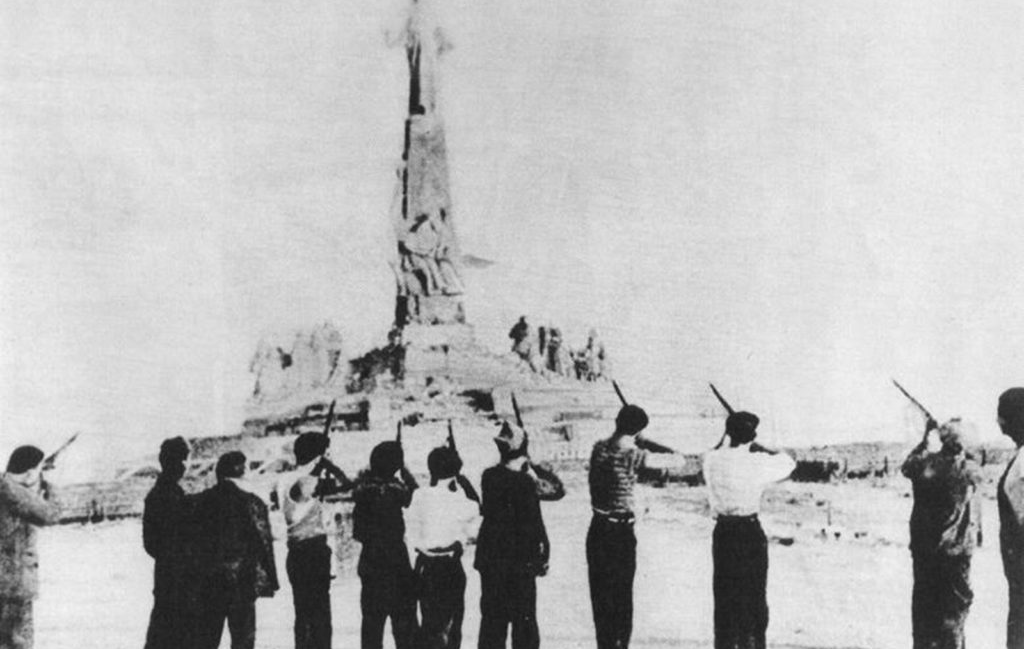
The time-honoured relationship between the secular and spiritual organs that had dominated the middle ages lay shattered, the Church itself grew weaker, and when, with glazed-over eyes, we human vermin saw heaven at long last fall to Earth, we were not impressed with what we saw. And when we learned to train our guns on priests, God did not save them.
It does not take much to see the sheer power in this. But this is not the power Nietzsche grasps. Nietzsche is the ultimate self-help philosopher; he attempts to explain the complexities of the modern world through developing the perfection of the human subject. Striding athwart the fallen heavens, the Übermensch is all that remains in lieu of God, to which the human race now aspires, as master of its own fate.
Curiously, we have yet to see these marching titans reach from the huddled masses to greatness. Our fates remain compelled to whims beyond our own. In lieu of God to comfort us, we have only the whiplash sting of minimum wage, which services a paltry, anemic existence that remains without escape. And no amount of self-sacrificial brilliance can climb the new pillars of God, seating the new patron saints of our ‘post-religious’ world, the despots of production, of industry, of finance, of capital. We cannot defy these glinting beacons. We can only kneel. We can shout our hatred all we like, but they are too high to hear.
The only answer is to pull out chisels to weaken the base. That, we can at least do from our knees.
I
There may be people stressing that I’m not getting Nietzsche, that I don’t understand him, et cetera, that I’m misrepresenting him because I’m not playing with his concepts as he provided them, that I don’t have the correct interpretation.
We will ignore these people. All theory worth a damn elucidates more than it raises questions of interpretation–we are not divining religious texts here at Negate!.
But I digress.
The main point here: ‘God’ may be dead, but abstract social domination is not. In fact, the tyranny over private life has grown firmer, and human affairs grow less discrete. God’s omnipotence is nothing in the face of Zuckerberg and Thiel.
But to the Christian Europe of the middle ages, the truth of religion was self-evident. While a cynicism of human motives would have existed in all rungs of society, we know that the notion of eternity, its division into salvation and damnation on behalf of one’s immortal soul, weighed heavy on the world of the time.
When a secular lord paid tithes to and purchased indulgence from the Church, we know in some cases it was to curry favour with powerful religious authorities, and in others it was out of sincere fear of eternal damnation. In both cases, however, it is the recognition of that Church as a supreme social authority and thereby exalting in ritual the reign of Christ.
Consolidated in the temples and parishes of all eras of Christendom is the cynicism of power but also its felt truth. Wielding with clenched fist the threat of excommunication, the Church moved to punish straying lords, and even though there remained fierce tumult and the struggle of power, this struggle was always on the terrain of spiritual authority–the investiture of bishops, the legitimacy of rite felt in the spats between Pope and Emperor.
Even the Protestant reformation, reflecting technological and social developments in the growth of towns and wealth of trade, was transmitted through translated prints of the very word of God’s disciples.
And because our records, accounts, and very understanding of history falls down from this written word, emblazoned with the ruling position of that past class society, we receive this religious understanding of society that falls down to the present, and concretises as the truth of the era. Only rationalised in retrospect and by a new social reality is this veil broken.
The intrigues of the eras, the lapses of faith, the sins and vices and great profanities that defrauded the integrity of the Christian religion are thus relegated to the petty minutiae of figures otherwise ruled by the dictates of history. As the faith itself proclaimed, all, in the end, is resolved into God’s own will.
II
The real critique of religion, then, does not arrive in the logical interrogations of God’s existence that eventually did away with religious necessity, but in the concessions formed out of the fall of God’s reign entirely.
As such, God is not slain by the Enlightenment’s exaltation of reason, that the absolute truth could be deduced through logic alone. Certainly, the contributions of classical philosophy that allowed the scrutiny of religious thought through logic are an essential part of its self-articulation, but that articulation alone does not in and of itself bring God’s ruin.
Only through the commercial centralisation of power, as well as the amounting of vast standing armies, could absolutist despots could bring to heel all the lay and clerical opponents alike, and in doing so sow the seeds of their own demise (as happened in France). And only in this did the Enlightenment find the power needed to impose the regard of God as a summit of logic on the minds of now almighty Kings, and not something achieved through raw faith.
As such, we see in the discredit of God not something achieved through Enlightened minds with new ideas, but through a position of the ruling class, encoded in their ruling ideas, but achieved in practice through the social domination now made felt through force of arms. These are not, however, an uneven duality, but fundamentally the same process.
As Marx and Engels remark in the German Ideology:
The ideas of the ruling class are in every epoch the ruling ideas, i.e. the class which is the ruling material force of society, is at the same time its ruling intellectual force. The class which has the means of material production at its disposal, has control at the same time over the means of mental production, so that thereby, generally speaking, the ideas of those who lack the means of mental production are subject to it. The ruling ideas are nothing more than the ideal expression of the dominant material relationships, the dominant material relationships grasped as ideas; hence of the relationships which make the one class the ruling one, therefore, the ideas of its dominance.
Hence, the ideology’s primacy felt through the ruling class is not a shadow on the wall, but simply the production of that ruling class, and a component of its supremacy, which then are “grasped as ideas”.
And as our oh-so mighty despots found, gathering more power they thought belonged to themselves, the social forces made felt in these developments were to bring about a new ruling class of far greater ambition. The aristocratic commanders of the regiment of the French Guards were powerless before the middle-class non-commissioned officers who actually ran the damned thing. And it was these men who, with their rifles, stormed the Bastille, helped launch the revolution, and fashioned of themselves the National Guard; and it was through those rifles that the revolution’s own ruling bourgeois ideas were felt.
Before that, the King and his nobility, who could together among themselves preserve the rule of their ‘divine right’, and in doing so mark history with its totality, set in stone a concrete order that preserved a their rule for an epoch. For so long they held in their hands the absolute favour of God, and that favour was real–but it was a favour expressed in social domination and ritual, not literal transcendent will.
The Bastille was a battle between heaven and Earth, and behind the elevated head of de Launay, the mobs of Paris dragged the broken corpse of God.
Following Thermidor, Napoleon, and the eventual return of the Bourbons, the Kings found their ‘absolute’ power once more, but they could not revive what was lost, and it would be felt forevermore the lack of Christ in the world of men. It is as Nietzsche puts it: God was dead, though that is where Nietzche’s claims on truth end. For this was not an execution at the hands of some broad humanity, but at the hands of a social class, in pursuit of social aims, establishing their own social reality.
This new reality composed the basic forces by which we live today.
III
We who claim the title of Communists know full well: political authority and the rule of states and classes is not a transhistorical reality at all. It is historically contingent. All things high and mighty can be broken.
Yet we cannot say this is a popular perspective. To most, in fact, the rule of the capitalist state is about as absolute as the religious authorities the bourgeoisie left slain. No matter how much worse things get, the fundamental belief in the longevity of the ‘human nature’ fostered by capital trumps any and all attempts to get people to believe otherwise.
In this moment of class retreat, we are left as peasants, trying to explain to our peers in vain that human volition is not the work of God. And people look at us like we’re crazy.
Humans didn’t build the skylines of our cities, say our superstitious, modern folk. Money did that. When’s it been about anything else?
The ontology beneath which we live trumps the simple and easily-explained notion that nothing like this lasts forever, especially in the worsening straits of our present crisis. The law of value is as ironclad as the rule of priests.
When power is uncontested, and appears total, and there is the slightest whiff of security in life that trumps the conscious nature of class struggle, even saying there is more than working a dead-end job to pay more than half your income to live in a shoebox is decried as radical. And at long last we understand the total dominance of past class societies.
For now, bourgeois rule may as well be an absolute, self-sustaining truth, value itself the essence of our human souls. Communism, by contrast, is impossible. Just as impossible as the establishment of democratic republics across Europe. That was never going to happen until it did.
What we must remember, then, is not that we are surrounded by mindless cattle, or that people simply are not desperate enough, or that the proletariat is permanently inert. None of these things are true. What is true is that for as long as there remains such a hegemony of capitalist production, and it remains unchallenged, people will not challenge it. Yet, as the Bolsheviks well knew, who fostered their doctrine and agitated uncompromisingly, who were regarded by the other parties as doomed extremists even as all practical state power was ceded over, who before their rise spent most their existence as a damned book club–everything seems impossible until it happens.
For the proletariat is a negative force, informed only by capital’s definite positions. We are not a competing gospel to the money-God, but the reflection of the social reality it has fostered. We are the barbaric forces summoned to work for a wage, we are those upon whom the system of global commodity exchange depends.
All the tools for the realisation of Communism are in our class’ hands. So I say again, pick up your damned chisel, and see if you can’t make a dent in the pillars of God.
Leave a Reply